
Beyond the Boom: The Unseen Structural Inflection in the Diet Drug Ecosystem Driven by GLP-1 Integration into Everyday Nutrition
GLP-1 (glucagon-like peptide-1) agonists like semaglutide are widely recognized for their immediate clinical impact in obesity and metabolic illness treatment. Yet, a larger and subtler inflection stands at the intersection of pharmaceutical innovation and food system transformation. This paper explores a non-obvious weak signal—the nascent integration of GLP-1 targeting compounds into mainstream food, beverage, and supplement products—that may fundamentally reshape capital flows, regulatory regimes, and competitive dynamics across health, nutrition, and pharma sectors over the next 5–20 years.
While attention focuses on semaglutide’s pharmaceutical patents, clinical approvals, and weight-loss outcomes, the emerging strategy by multinational food companies to embed GLP-1 modulation within ordinary consumables poses a structural challenge to existing industrial boundaries and regulatory orthodoxies. This signal is insufficiently recognized in prevailing forecasts about the diet drug market and obesity management as it portends a paradigm shift from reactive therapeutic use toward proactive, embedded appetite and metabolism regulation.
Signal Identification
This development is classified as an emerging inflection signal. It extends beyond an incremental trend by coupling pharmacological innovation with food product innovation, signaling a potential structural evolution in how weight management and metabolic health are targeted societally. Its plausibility is high, grounded in converging advances in GLP-1 science, regulatory approvals, and corporate strategy expansions, with a time horizon of 5 to 10 years for initial scaling and 10 to 20 years for full industrial maturation. The sectors affected include pharmaceuticals, food and beverage, nutraceuticals, healthcare delivery, and regulatory agencies.
What Is Changing
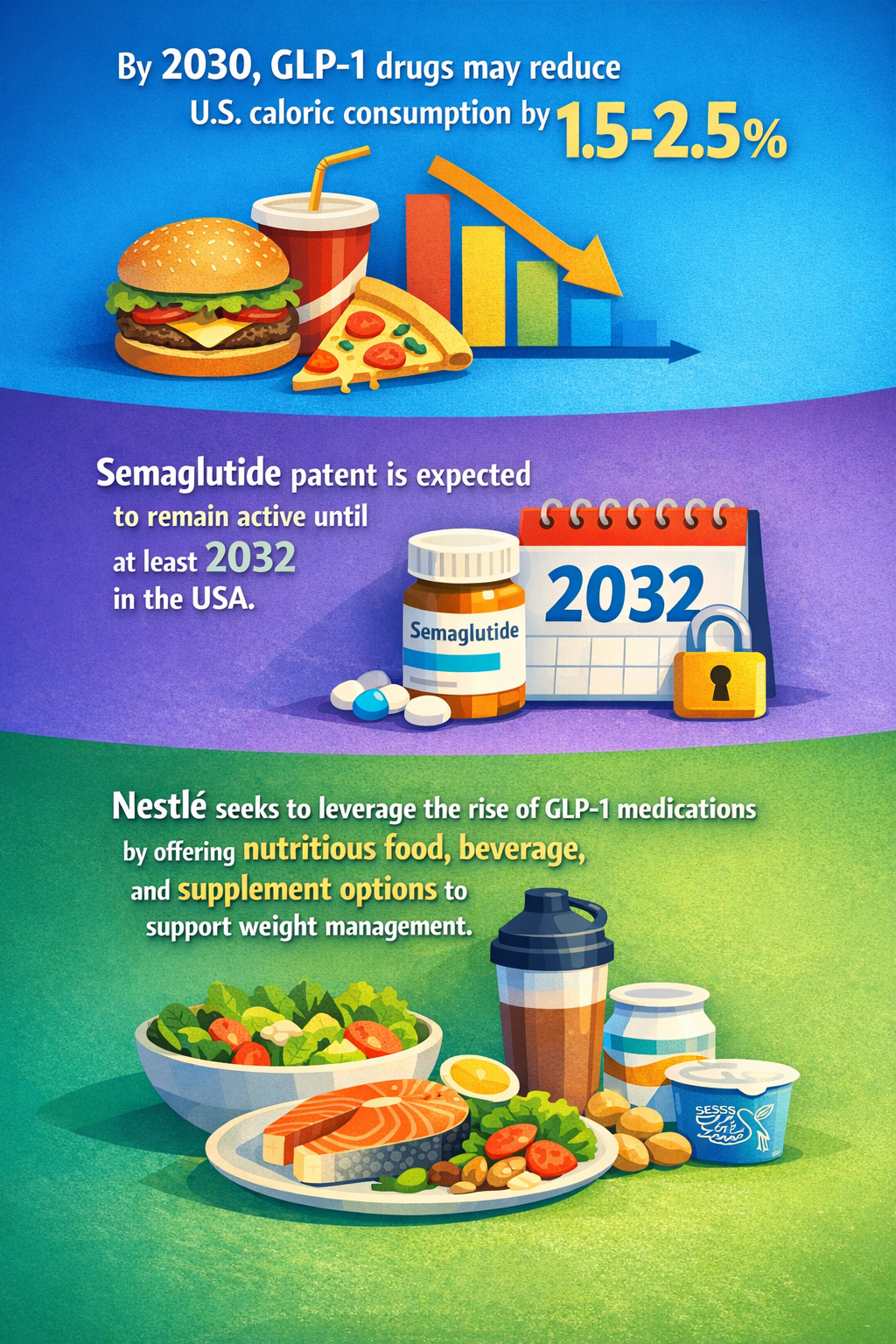
The pharmaceutical success of GLP-1 receptor agonists such as semaglutide—best known under brand names like Wegovy—has catalyzed an entirely new class of diet drugs with proven efficacy in weight loss and cardiovascular benefit, holding patents until at least 2032 in the U.S. (Treated.com 04/04/2023). Yet, while clinical weight management remains the dominant narrative, the signal lies in the strategic moves by major food industry players like Nestlé, who foresee use cases for GLP-1 mechanisms in developing convenient, nutritious food, beverage, and supplement options tailored to caloric control and metabolic health (Food Ingredients First 18/01/2024).
Current modeling estimates that widespread adoption of GLP-1 drugs could reduce average caloric intake across the U.S. by 1.5–2.5% by 2030, signaling a demand-side behavioral shift tied to biochemical appetite regulation (Peptide Explorer 02/12/2023). This downward pressure on calorie consumption, historically sticky in public health efforts, is poised to disrupt the food sector fundamentally from within.
Simultaneously, Wegovy’s FDA approval to reduce major cardiovascular event risk and treat nonalcoholic steatohepatitis underscores the broadening clinical value of GLP-1 drugs beyond weight loss (Noom Blog 15/11/2023). Such endorsements amplify the legitimacy of GLP-1 pathways as multipurpose metabolic regulators, which can, in turn, embolden food companies to incorporate bioactive compounds or mimic metabolic triggers in functional foods and supplements.
The core structural theme is the blurring of boundaries between pharmaceuticals and food systems—where once diet drugs were confined to prescription medication spheres, their mechanisms are being appropriated into everyday consumables, potentially redefining how metabolic health management is delivered at scale.
Disruption Pathway
This signal may evolve into a structural change through the gradual normalization of pharmacodynamic effects in consumer products. Initially, as patent protections for drugs like semaglutide run their course, pressure on brands and pharmaceutical incumbents to innovate beyond prescription-only delivery will mount. Nestlé and similar players investing in GLP-1-inspired food technologies will accelerate product launches in the 5–10-year horizon, leveraging consumer demand for accessible metabolism management solutions.
This evolution introduces stresses to regulatory and industrial systems. Traditional regulatory frameworks bifurcate pharmaceuticals (subject to strict approval and marketing controls) and foods (regulated for safety and nutrition but not drug claims). The infusion of GLP-1 mimetics into foods and supplements will challenge these distinctions, creating ambiguity over approval pathways, health claims, and safety monitoring. Regulators may be compelled to develop hybrid frameworks, affecting capital allocation by increasing compliance costs or expediting new product entry.
Industrial structures could shift as vertically integrated corporations straddle pharmaceutical and food manufacturing, potentially marginalizing firms specialized exclusively in either domain. Established pharmaceutical business models predicated on high-margin, prescription-bound innovation risk disruption as food companies adopt metabolic modulators in mass-market products, driving a commoditization of diet drug effects.
A feedback loop may emerge: increased consumer access to GLP-1 analog functional foods could reduce demand for clinical prescriptions, pressuring healthcare payers and providers to reconsider reimbursement models and clinical protocols. Simultaneously, adverse events or unexpected interactions from widespread pharmacologic food fortification may provoke liability challenges, prompting further regulatory tightening or market exit for non-compliant firms.
Over time, governance models may move from isolated pharmaceutical oversight toward integrated metabolic health governance frameworks encompassing food safety, drug efficacy, and consumer protection. Dominant industry players will be those that successfully navigate and influence these emerging regulatory and consumer landscapes.
Why This Matters
From a decision perspective, this inflection impacts multiple facets. Capital allocation decisions must consider the convergence of pharmaceutical and food sectors—investments in R&D, supply chain adaptation, and manufacturing capacity will likely pivot toward integrated metabolic health product portfolios. Regulatory exposure heightens as agencies grapple with innovative hybrid products that defy conventional classification, increasing compliance risks and opportunities for regulatory arbitrage.
Competitive positioning requires reassessment: incumbents in both the pharma and food industries may face disruption by new entrants bridging these domains. Supply chain strategies will need to adapt to the sourcing of bioactive ingredients at scale, as well as to address formulation challenges balancing efficacy, taste, and consumer acceptability.
Shifted liability regimes may emerge as consumer expectations for safety and benefit claims rise, especially when pharmacologic effects become embedded in commonly consumed products. Governance frameworks will evolve toward metabolic health as a strategic axis, blending nutrition science, pharmacology, and consumer protection in novel ways.
Implications
This development could ultimately redefine how weight management is embedded into everyday life, making metabolic regulation an ongoing nutritional practice rather than episodic clinical intervention. It may precipitate adjustments in healthcare expenditure models by potentially lowering long-term obesity-related costs through population-wide caloric and appetite modulation.
However, it is not a guaranteed panacea. This structural change should not be mistaken for a simple extension of current diet-drug hype or short-term pharmaceutical sales growth. It might fail to scale if regulatory frameworks solidify traditional boundaries or if consumer acceptance of pharmacologically active food products remains low. Competing interpretations exist that regard such integration as niche or unfeasible due to safety and efficacy complexities in non-prescription contexts.
Nonetheless, the interplay of persistent pharmaceutical innovation, corporate food system strategies, and evolving health needs suggests a high likelihood of transformation in the intersection of diet drugs and nutrition markets over the next two decades.
Early Indicators to Monitor
- Patent filings and proprietary formulations blending GLP-1 agonists or analogs with food matrices.
- Strategic investments and partnerships between pharmaceutical companies and major food producers.
- Regulatory agency discussion papers or draft frameworks addressing “pharma-nutrition” hybrid products.
- Consumer product launches explicitly citing appetite or metabolic modulation mechanisms.
- Rising venture capital activity in startups developing bioactive food ingredients targeting GLP-1 or similar pathways.
Disconfirming Signals
- Crackdown or clarifications from regulators enforcing strict separation of drugs and foods.
- Clinical safety or efficacy failures of GLP-1 analogs outside tightly controlled pharmaceutical contexts.
- Consumer rejection due to taste, cost, or ethical perceptions of “medicated” foods.
- Patent life extension or dominant pharmaceutical exclusivity preventing competitive hybrid product emergence.
- Pharmaceutical companies doubling down on prescription-only, high-margin business models without crossover engagement.
Strategic Questions
- How should pharmaceutical and food sector actors realign R&D and partnership strategies to capture or defend emerging market segments?
- What regulatory innovations or collaborations will be needed to ensure safety without stifling innovation in metabolic health products?
Keywords
GLP-1; weight management; pharma-nutrition; regulatory frameworks; metabolic health; functional foods; capital allocation; industrial strategy
Bibliography
- The rise of GLP-1 medications has created an opportunity for Nestle to serve consumers in new and different ways by offering convenient, nutritious food, beverage, and supplement options that can support their weight management goals. Food Ingredients First. Published 18/01/2024.
- Wegovy is FDA-approved to reduce the risk of major cardiovascular events in certain adults with cardiovascular disease and to treat adults with noncirrhotic metabolic dysfunction-associated steatohepatitis with moderate-to-advanced liver fibrosis. Noom Blog. Published 15/11/2023.
- The patent for semaglutide is expected to remain in place until at least 2032. / USA. Treated.com. Published 04/04/2023.
- GLP-1 drugs could reduce caloric consumption across the U.S. population by 1.5 to 2.5% by 2030. Peptide Explorer. Published 02/12/2023.
- Additional market context and consumer access considerations for GLP-1-based interventions emerging from pharmaceutical and nutrition sector intersections. Food Ingredients First. Published 18/01/2024.