
The Quiet Revolution of AI-Driven Satellite Networks: The Future of Autonomous Space Connectivity
Space-based internet infrastructure is on the cusp of a transformational shift driven by artificial intelligence integration and next-generation satellite technologies. What began as conventional satellite communications is evolving into a self-optimizing, intelligent constellation model that could disrupt multiple industries, from telecommunications to urban infrastructure and logistics. A weak but increasingly visible signal is the introduction of reinforcement learning algorithms enabling autonomous traffic management in satellite networks, notably pioneered by SpaceX’s Starlink Gen3 satellites. This development carries implications that stretch beyond enhanced connectivity, potentially reshaping how data flows globally and how public and private sectors build future digital ecosystems.
What’s Changing?
The most profound change emerging in satellite communications is the integration of reinforcement learning-based AI to autonomously manage network traffic and orbital behavior. Starlink Gen3 satellites, expected to be operational in the near future, are designed to reroute data dynamically, avoiding congestion not only on the network but also physically in orbit around Earth (Source: IDSTCH). This autonomous rerouting is significant because it signals a move away from static, human-operated satellite management toward AI-managed constellations capable of self-optimization at scale.
Alongside this technological leap, Starlink's satellite network growth is supported by anticipations of a high-value Initial Public Offering (IPO) that could reach approximately US$1.5 trillion by 2026, largely driven by Starlink’s expansion (Source: Sophic Capital). This would substantially increase investment and accelerate innovation cycles around space internet and related services.
Further technical advances are expected in inter-satellite link technology. In 2025 and beyond, hybrid optical and microwave inter-satellite links could power a new generation of orbital internet, combining the high bandwidth of optical connections with the reliability of microwave technology to maintain resiliency and speed (Source: IDSTCH). This development is critical for handling the volume and complexity of traffic in dense satellite constellations.
Collision avoidance is also being revolutionized through AI. Starlink satellites are reported to maneuver autonomously to avoid collisions with a probability threshold as low as 3 in 10 million, vastly improving on the industry standard of 1 in 10,000. This suggests a future in which satellite assets can dynamically adapt their orbits based on real-time risk assessments governed by AI (Source: The Register).
The broader telecommunications landscape is evolving as well. With 6G expected by 2030 tapping into the terahertz spectrum for speeds approaching 1 terabit per second, terrestrial and space-based networks will likely need to merge seamlessly to handle emerging demands such as real-time holographic streaming (Source: TechTimes).
Urban infrastructure and IoT ecosystems stand to benefit from these satellite advances. Los Angeles aims to launch an open-source IoT integration platform in 2026 developed through public-private partnerships, hinting at future smart cities dependent not only on terrestrial 5G but also complementary satellite connectivity for coverage and resilience (Source: CCE Online News).
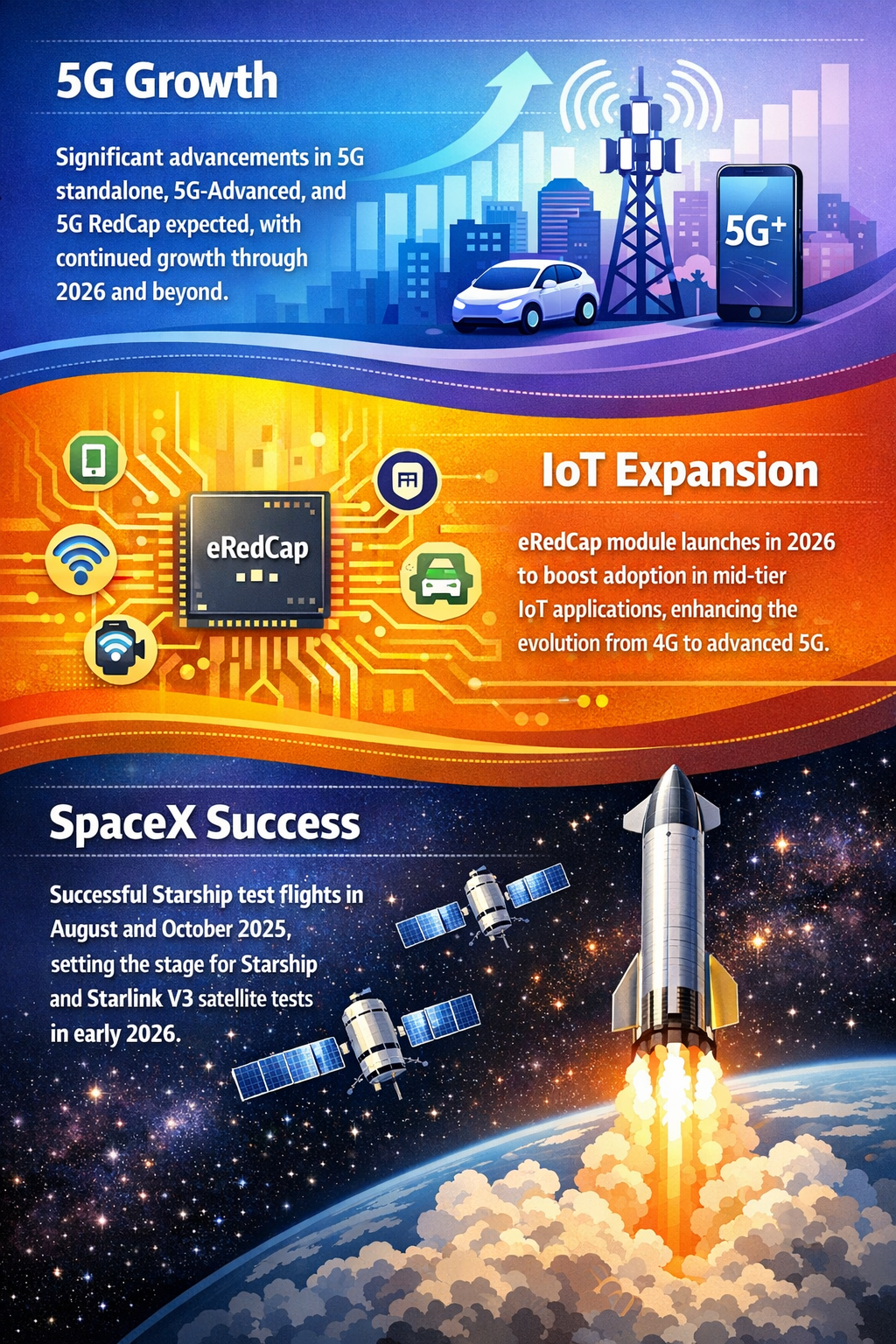
At the intersection of these trends is the exponential growth of IoT-connected devices, expected to double in the next five years. With 5G RedCap technologies bridging gaps between 4G and advanced 5G, satellite networks may soon support mid-tier IoT applications directly using new direct-to-cellular satellite services, such as those on Starlink V3 satellites (Source: RV Mobile Internet).
Why Is This Important?
These advancements imply a pivotal transformation in global connectivity infrastructure. Autonomous AI-driven satellite constellations could deliver higher reliability and greater flexibility compared to traditional terrestrial networks constrained by geography and infrastructure costs. In industries such as logistics and supply chain management, improved end-to-end visibility, enabled by ubiquitous, low-latency global connectivity, might become a norm rather than an exception (Source: Supply Chain and Logistics Assoociation of Australia).
The ability of AI to dynamically manage orbital traffic and prevent collisions reduces risks of satellite loss and space debris generation. This directly supports the sustainability of space ecosystems—a growing concern as constellations multiply—and preserves critical infrastructure needed for climate monitoring, navigation, and communication.
For governments and regulators, autonomous self-optimizing satellites challenge existing frameworks designed around human-monitored space traffic management. Regulatory bodies may need to develop more adaptive, algorithm-aware policies to manage operational risks and spectrum allocations effectively.
Public-private partnerships in smart city developments demonstrate how space-enabled connectivity will be foundational for next-generation urban services such as autonomous vehicles, energy grids, and health monitoring, allowing broader population coverage where fiber or terrestrial 5G is unavailable or infeasible.
Investors in the satellite internet sector may find unprecedented opportunities in companies deploying AI-managed constellations and integrating satellite and terrestrial networks. The projected soaring valuations and revenue growth—illustrated by SpaceX’s expected IPO and revenue from Starlink—reflect strong market interest and potential (Source: The Verge).
Implications
Organizations should reassess their connectivity strategies with anticipation of AI-driven satellite networks playing a core role. Enterprises reliant on global data flows—such as logistics companies, remote healthcare providers, and IoT platform operators—may need to explore satellite services as a primary or redundant connectivity layer.
Governments and regulatory agencies ought to prepare for the emergence of autonomous orbital traffic management by developing standards that accommodate AI decision-making processes, data transparency protocols, and dynamic spectrum sharing frameworks. Collaboration between satellite operators, AI developers, and policymakers could ensure safe, equitable, and sustainable orbital environments.
Technology vendors and system integrators will likely find demand for new tools that support integration of AI-managed satellites with terrestrial 5G/6G, edge computing, and spatial computing infrastructures. This convergence will encourage development of hybrid networks and digital twin applications modeling physical and network dynamics in real time.
Urban planners and public-private partnerships should consider the expanding role of satellite connectivity in smart city frameworks, specifically to alleviate coverage gaps and increase resilience against network disruptions. This may involve adopting open standards and interoperable platforms to unify terrestrial and satellite IoT ecosystems.
Investors may want to monitor AI satellite constellation technologies and adjacent innovations in inter-satellite communications and direct-to-cellular satellite services. Identifying companies effectively combining AI and satellite hardware could uncover transformative opportunities before these trends reach mainstream awareness.
Questions
- How will AI-managed satellite constellations transform existing network infrastructure and data management practices in your sector?
- What steps should regulatory bodies take now to prepare for autonomous orbital operations and dynamic spectrum management?
- In what ways can organizations integrate satellite-based connectivity with terrestrial 5G/6G networks to ensure resilient, high-quality service delivery?
- How might IoT ecosystems evolve when mid-tier applications are increasingly supported by direct-to-cellular satellite services?
- What partnerships between governments, satellite operators, and technology providers can best leverage these emerging capabilities for societal benefit?
Keywords
AI Satellite Networks; Starlink Gen3; Reinforcement Learning; Autonomous Orbital Traffic Management; 6G Connectivity; Hybrid Inter-Satellite Links; Satellite IoT; Space Traffic Management; Direct-to-Cellular Satellite Service; Smart City Connectivity
Bibliography
- 2025’s Space Connectivity Breakthrough: Hybrid Optical and Microwave ISLs Powering the New Orbital Internet. IDSTCH. https://idstch.com/space/2025s-space-connectivity-breakthrough-hybrid-optical-and-microwave-isls-powering-the-new-orbital-internet/
- December 14 2025 AI Trade Under Pressure. Sophic Capital. https://sophiccapital.com/december-14-2025-ai-trade-under-pressure/
- Crash Clock Orbit Collision: Starlink’s AI Avoidance Techniques Push Limits. The Register. https://www.theregister.com/2025/12/12/crash_clock_orbit_collision/
- How 5G Soon Arrive: 6G Will Transform Global Connectivity, Healthcare, Transportation. TechTimes. http://www.techtimes.com/articles/313244/20251213/how-5g-soon-arrive-6g-will-transform-global-connectivity-healthcare-transportation.htm
- America’s Biggest Smart City Projects Set for 2026. CCE Online News. https://cceonlinenews.com/construction/projects/americas-biggest-smart-city-projects-set-for-2026/
- Late 2025 Satellite Mobile Internet Update: Amazon LEO Getting Ready to Roar, HughesNet Bowing Out, Viasat Back on Track, SpaceMobile Going Big and More. RV Mobile Internet. https://www.rvmobileinternet.com/late-2025-satellite-mobile-internet-update-amazon-leo-getting-ready-to-roar-hughesnet-bowing-out-viasat-back-on-track-spacemobile-going-big-and-more/
- What Awaits the Logistics and Supply Chain Industry in 2026. Supply Chain and Logistics Association of Australia. https://www.sclaa.com.au/what-awaits-the-logistics-and-supply-chain-industry-in-2026/
- Elon Musk's Starlink Expected to Reach $22 to $24 Billion in 2026 Revenue. The Verge. https://www.theverge.com/archives/elon-musk/2025/12/1