
Reconfigured Global Trade Networks: A Weak Signal Disrupting Multilateralism and Economic Interdependence
Global trade is entering a period of profound transformation marked by the weakening of established multilateral frameworks and the rise of networked, pragmatic arrangements. A key weak signal emerging from recent developments is the reshaping of global trade infrastructure—not through rapid liberalization, but through strategic re-routing, bilateralism, and adaptive regional cooperation. This reshaping may disrupt industries reliant on traditional supply chains, requiring businesses and governments to anticipate novel risks and opportunities.
What’s Changing?
The landscape of global trade is evolving under simultaneous, interlinked pressures: shifting geopolitics, technological advances, and changing governance models. Recent reports signal nuanced shifts rather than abrupt reversals that many hoped for after the disruptions of the late 2010s and early 2020s.
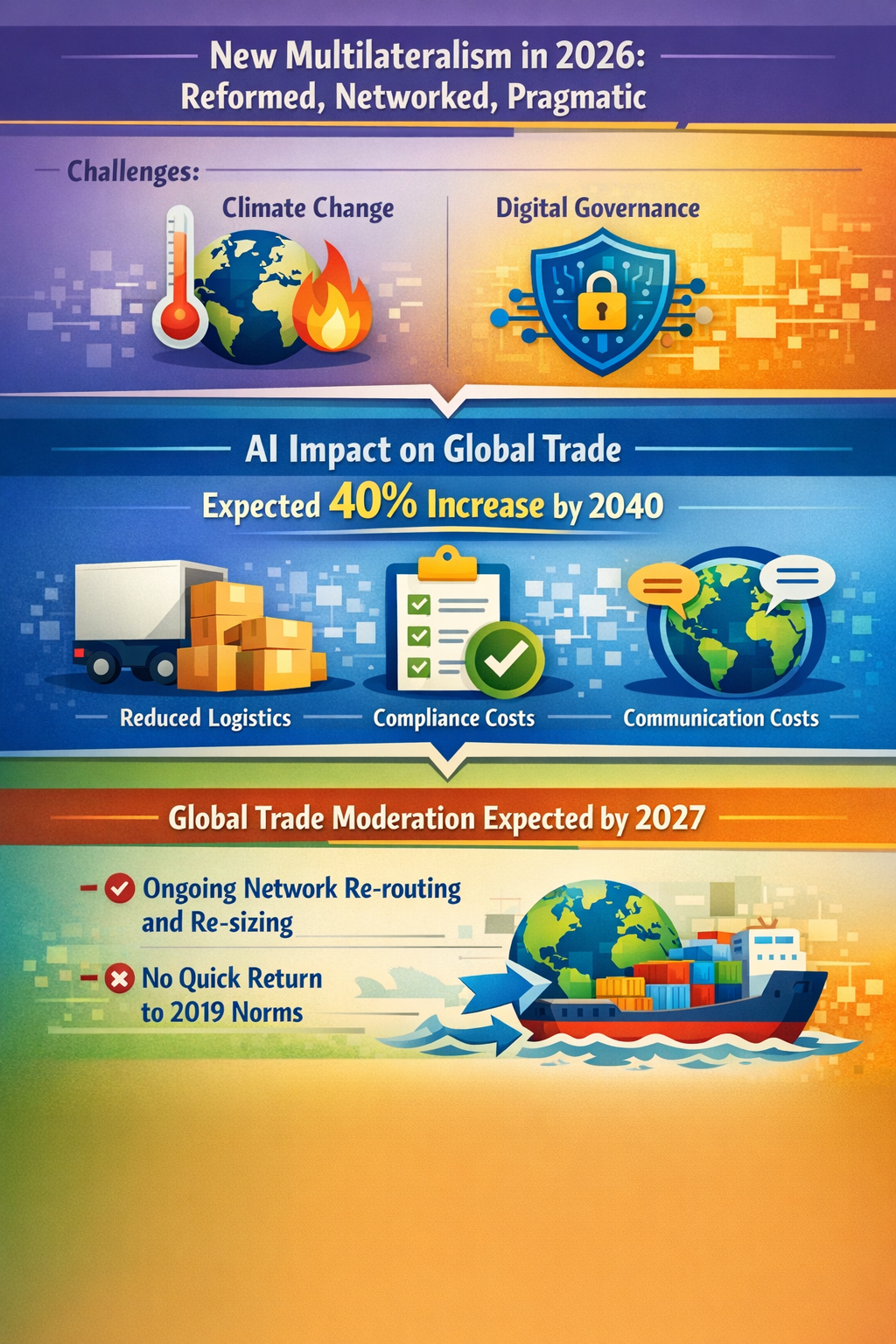
First, trade intensity is expected to moderate in 2027, with firms continuing to re-route and resize their supply networks rather than returning to pre-pandemic normalcy (The DCN). This signals a departure from traditional assumptions around linear globalization and highlights company-level efforts to increase resilience over efficiency. Rather than focusing solely on cost reduction, companies are investing in diversified supply chains that reduce exposure to geopolitical and logistical shocks.
Second, the role of multilateralism is being reshaped rather than revived. The Trump administration’s retreat from multilateral frameworks in favor of bilateral deals has weakened the collective bargaining power of blocs such as the World Trade Organization (WTO), diminishing hope for quick revival (Straits Times). Conversely, countries in the BRICS group, led by India’s multilateral agenda during its presidency, are striving to strengthen global cooperation but outside traditional western-led institutions (TRT Afrika). This tug-of-war suggests future governance may become more fragmented yet pragmatic, with regional and issue-specific coalitions replacing broad global accords.
Third, China’s increasing economic interdependence with Seoul and Tokyo post-WTO entry has created complex tripolar trade relations, deterring overt conflict but embedding vulnerabilities in regional supply chains (Special EurAsia). This dynamic could lead to more intricate interdependencies where industries face ripple effects from diplomatic tensions or embargoes despite efforts to diversify.
Moreover, emerging technologies such as Artificial Intelligence (AI) are being integrated into trade logistics, regulatory compliance, and communications. A recent WTO report estimates AI could boost trade value by up to 40% by 2040 while simultaneously reducing operational costs (Global Trade Magazine). These digital shifts may accelerate the adaptation of trade routes and protocols but could also widen disparities between technologically advanced economies and those without the infrastructure to leverage AI.
Finally, the evolution of a “new multilateralism”—networked and pragmatic rather than institutional and universal—is expected to continue. This model adapts to climate imperatives, digital governance challenges, and geopolitical turbulence without attempting to resurrect old governance forms (WGI.world). As a consequence, trade governance may become more fragmented but more flexible, with alliances forming around specific industries, technologies, or climate goals rather than broad commerce.
Why is This Important?
The reconfiguration of global trade networks presents both opportunities and risks across multiple sectors. Companies embedded in complex supply chains may find traditional risk assessments obsolete as supply diversification, geopolitical risk, and regulatory scrutiny increase simultaneously.
For example, industries like electronics, automotive, and pharmaceuticals, which depend on tightly integrated supply chains spanning Asia, Europe, and the Americas, could face increased costs from ongoing “re-routing” of trade networks. This may involve greater inventory holdings, alternative supplier development, and increases in compliance expenditures.
On a governance level, the weakening of global trade institutions like the WTO could increase transaction costs and heighten trade disputes, reducing predictability for multinational enterprises. Yet the rise of new multilateral coalitions—such as BRICS countries working to reform global governance structures—may offer alternative avenues for dispute resolution and collective action in emerging markets (Valdai Club).
Technologically, the integration of AI into trade logistics could drastically reshape operational models but poses challenges around regulatory frameworks, data governance, and equitable access. Economies insufficiently prepared to integrate AI may face competitive disadvantages or exclusion from emerging trade ecosystems.
Finally, the growing regional interdependence in Asia, especially among China, South Korea, and Japan, may make this hub a critical flashpoint for trade disruption or cooperation. Business strategies will need to factor in both the fragility and resilience embedded in these interconnected economic relationships.
Implications
The trade network shifts outlined here invite multi-sectoral responses incorporating strategic foresight, operational flexibility, and governance innovation.
- Strategic Supply Chain Design: Business leaders must design supply chains with multilayered redundancy, accounting for geopolitical risk as a core factor. Investing in digital tools for supply visibility and risk prediction will become essential.
- Engagement with New Governance Models: Governments and multinational businesses may find greater value engaging in regional or issue-specific trade alliances, especially those including BRICS countries, rather than solely relying on legacy multilateral trade agreements.
- Technology Integration and Workforce Readiness: Early adoption of AI-enabled trade facilitation tools can reduce operational costs and enhance agility but will require investment in workforce skills and regulatory compliance mechanisms.
- Scenario Planning for Regional Risks: The Asia-Pacific nexus of trade could become both an anchor and a vulnerability; extended scenario planning should evaluate the impacts of regional diplomatic tensions, supply disruptions, and cooperative win-win opportunities.
- Climate and Digital Governance Coordination: Companies and governments should prepare for trade regulations increasingly tied to climate commitments and digital governance standards, necessitating collaboration across sectors and jurisdictions.
This complex, evolving environment favors actors capable of rapid adaptation, anticipating non-linear risks, and embracing networked models rather than traditional hierarchical ones. Early identification and integration of these weak signals into long-term strategic planning may yield competitive advantages.
Questions
- How can supply chain resilience be enhanced beyond simple diversification to address intertwined geopolitical and technological risks?
- What role could emerging multilateral coalitions, such as BRICS or regional trade bodies, play in shaping the future of global trade governance?
- How might AI-enabled logistics and compliance reshape cost structures and competitive dynamics in critical industries?
- In what ways should businesses prepare for the rising importance of regional dependencies, particularly in the Asia-Pacific trade ecosystem?
- How will climate change and digital governance intersect with trade networks to create new regulatory landscapes in the coming decades?
Keywords
global trade; supply chain resilience; multilateralism; BRICS; artificial intelligence in trade; trade governance; Asia-Pacific trade; digital governance; climate change regulation
Bibliography
- Asia-Pacific risk 2026: economic interdependence in Northeast Asia. Special EurAsia. https://www.specialeurasia.com/2026/01/07/asia-pacific-risk-2026/
- Industry opinion: The year ahead and what we learned from the one just gone. The DCN. https://www.thedcn.com.au/news/industry-opinion-the-year-ahead-and-what-we-learned-from-the-one-just-gone
- What’s ahead for Asia in 2026. Straits Times. https://www.straitstimes.com/asia/whats-ahead-for-asia-in-2026
- India’s BRICS presidency defends multilateralism. TRT Afrika. https://www.trtafrika.com/english/article/93813e7f5f7c
- 2026 Global trade outlook: What to watch on AI. Global Trade Magazine. https://www.globaltrademag.com/2026-global-trade-outlook-what-to-watch/
- Multilateralism will redefine world order in 2026. WGI.world. https://www.wgi.world/multilateralism-will-redefine-world-order-in-2026/
- The second Trump administration and UN future: expanding BRICS. Valdai Club. https://valdaiclub.com/a/highlights/the-second-trump-administration-and-UN-future/