
The Rising Influence of AI-Driven Productivity on Global Income Inequality and Social Stability
Artificial intelligence (AI) is increasingly transforming productivity across industries, promising unprecedented efficiency and economic growth. However, a weak signal emerging from recent data suggests that the benefits of AI-driven productivity improvements may not be equitably distributed, potentially exacerbating global income inequality and social unrest. This trend could disrupt labor markets, social contracts, and geopolitical stability in the coming decade.
What’s Changing?
The integration of AI into business operations is improving productivity at scales previously unattainable. According to recent insights, companies leveraging AI technologies to boost output and efficiency are seeing significant gains. However, the associated wage growth and job creation have not kept pace with these productivity improvements, leading to a widening income gap (Asiae, 2026; EWeek, 2024).
Meanwhile, inflationary pressures fueled by global disruptions and compounded economic shocks are further heightening income disparities. Rising costs disproportionately impact lower-income groups, polarizing markets and fueling social tensions (Euromonitor, 2025). The confluence of AI-driven productivity benefits accruing primarily to capital owners and executives, combined with stagnant wages for the majority of workers, signals an emerging socioeconomic divide.
In parallel, geopolitical tensions and trade conflicts, such as those between major economies, could accelerate these disparities through disrupted supply chains and localized inflation spikes (Tekedia, 2024; RSIS International, 2025). For example, tariffs and climate-induced resource shortages threaten food security and affordability, which disproportionately affects vulnerable populations and could lead to widespread social disruption and unrest (Agribusiness Global, 2026; Global Reinsurance, 2026).
Historically stable democracies are exhibiting signs of distress amid growing political polarization, fueled in part by economic volatility and perceived inequality (Journal of Democracy, 2025; Next Generation Equity, 2024). These dynamics hint at a future where socio-political stability might be increasingly fragile if income inequality continues unchecked and if AI-enabled productivity gains remain unevenly distributed.
Why is this Important?
The importance of this trend lies in its potential to destabilize economies and societies in multiple ways. First, persistent or worsening income inequality can erode consumer demand, limiting the broad-based economic growth that AI productivity stands to generate. Economies may face stagnation despite technological advances if most individuals experience relative economic decline.
Second, the risk of social unrest may rise as disadvantaged groups protest against perceived economic injustice and government inaction. The likelihood of larger and more intense protests in 2026 than in previous years underlines this threat (Global Reinsurance, 2026). Such unrest could disrupt industries dependent on social stability, including manufacturing, agriculture, and services.
Third, the geopolitical landscape could shift as nations adopt inward policies to safeguard domestic interests, further fragmenting global trade and collaboration. This could undermine innovation diffusion and international problem-solving efforts, particularly relevant given the global challenges related to climate change and food security.
Finally, on an organizational level, industries might confront talent shortages, wage inflation, and shifts in consumer behavior. Businesses that fail to anticipate these changes may experience operational disruptions, reputational damage, or loss of market share.
Implications
Organizations, governments, and civil society actors need to recognize that AI-driven productivity gains might not automatically translate into societal benefits. Thus, proactive measures to ensure more equitable distribution of these gains will prove pivotal. This may involve:
- Implementing policies or business models that share productivity benefits across the workforce, such as profit-sharing, retraining programs, and raising minimum wages.
- Designing social safety nets and fiscal interventions that address inflationary pressures on vulnerable populations.
- Monitoring and mitigating the risks of supply chain disruptions caused by trade conflicts and climate-related shocks to prevent food insecurity and its social consequences.
- Fostering international cooperation to address geopolitical fragmentation and maintain stable trade and investment environments.
- Adapting corporate strategic intelligence approaches to include scenario planning on inequality-induced risks and social unrest to better anticipate disruptions.
Without these adaptations, industries may face accelerating disruptions from social instability and shifting consumer demands. Governments that fail to address widening disparities risk losing legitimacy, while businesses that ignore these trends could be blindsided by disruptive protests and volatile markets.
Questions
- How can corporations incorporate equitable benefit-sharing into AI-driven productivity strategies without sacrificing competitiveness?
- What fiscal and social policies can governments enact to mitigate the inflationary pressures exacerbating income inequality?
- Which early warning indicators should organizations monitor to anticipate social unrest fueled by economic disparities?
- How can international cooperation be strengthened to manage the intersecting risks of AI-driven inequality and geopolitical instability?
- What workforce reskilling and transition programs are necessary to prepare for structural labor market changes induced by AI?
Keywords
AI driven productivity; Income inequality; Social unrest; Inflation; Geopolitical risks; Trade conflicts; Scenario planning; Workforce reskilling
Bibliography
- Productivity improvements could worsen income inequality, emphasizing, We need to find ways for the benefits of AI-driven productivity improvements to be shared across society. Asiae. https://cm.asiae.co.kr/en/article/2026010414402727492
- AI is widening global income inequality and outlines a plan to harness its potential more equitably. EWeek. https://www.eweek.com/news/un-ai-report-inequality-jobs/
- Rising income inequality, driven by compounded inflation effects and global disruptions, is polarising markets. Euromonitor. https://www.euromonitor.com/article/economic-outlook-for-2025-qa-geopolitical-risks-and-policy-uncertainty-as-top-business-concerns
- Economic slowdown risks social unrest, but Beijing's pivot to domestic markets and state subsidies mitigates some pressures. Tekedia. https://www.tekedia.com/the-trade-war-is-hastening-u-s-china-economic-decoupling/
- If tariffs collide with climate-induced crop shortages, the global food system will face a double whammy of food inflation and social unrest. Agribusiness Global. https://www.agribusinessglobal.com/markets/global-agriculture-forecast-2026-continued-volatility-and-needed-adaption-ahead/
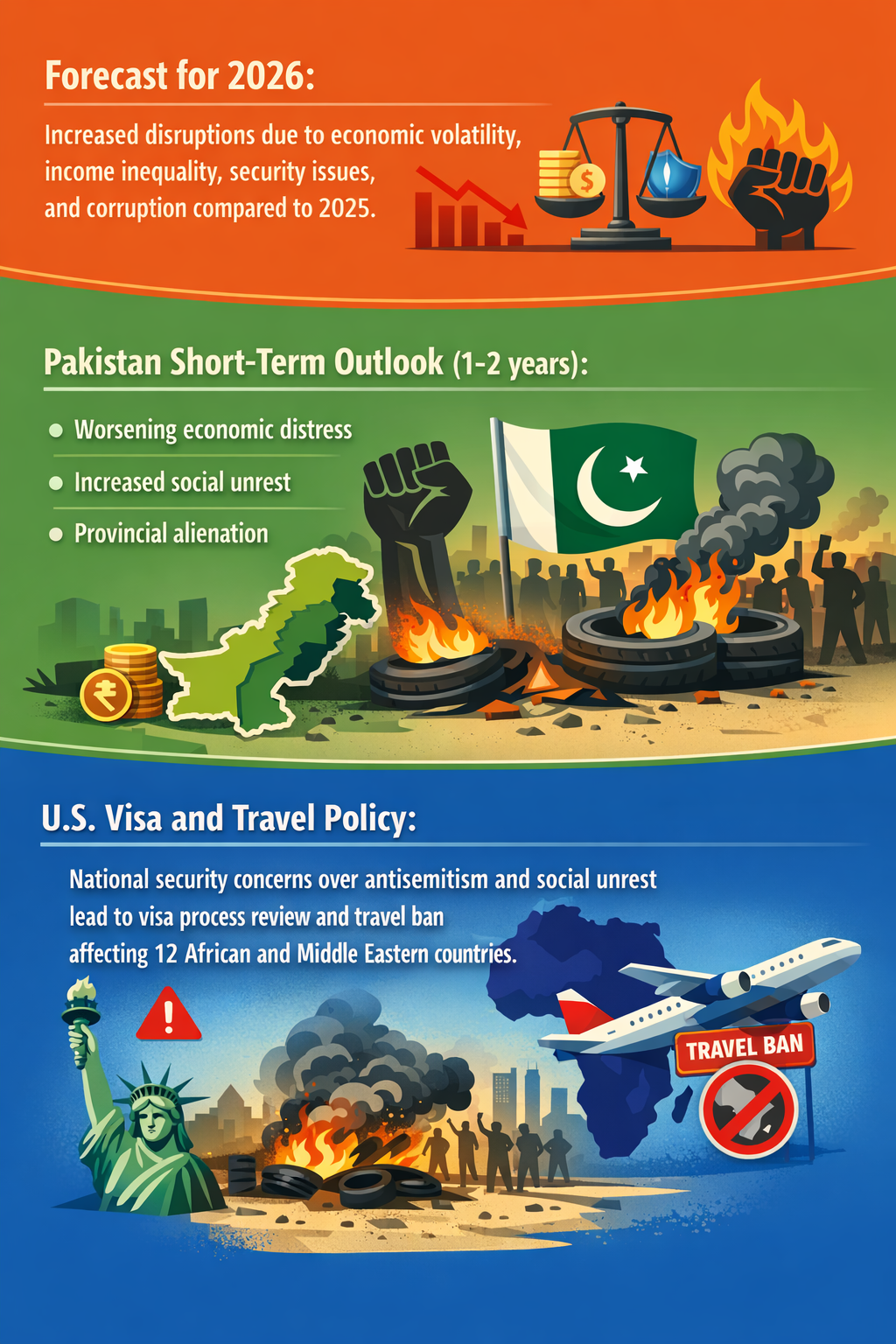
- Based on the frequency and intensity of protests and the underlying factors that drive unrest, such as economic volatility, income inequality, the conduct of security forces, and corruption, we expect in 2026 to be more disruptive than 2025. Global Reinsurance. https://www.globalreinsurance.com/home/civil-unrest-risks-set-to-intensify-in-2026-verisk-maplecroft-warns/1457204.article
- Liberals celebrated the Polish example as a signal case of democracy fighting back against an illiberal threat, with lessons for other European countries facing a resurgence of radical-right populism. Journal of Democracy. https://www.journalofdemocracy.org/articles/democracy-after-illiberalism-a-warning-from-poland/
- While the US has long been viewed as a beacon of democracy and opportunity, recent elections, social unrest, and divisive political rhetoric have led many to consider backup plans. Next Generation Equity. https://www.nextgenerationequity.com/blog/second-passport-for-us-citizens/
- Similar concerns apply to Cambodia and Laos, where emerging industries may not be able to absorb the sudden cost increase, possibly triggering widespread disruptions and social unrest. RSIS International. https://rsisinternational.org/journals/ijriss/articles/impact-of-trumps-2025-liberation-day-tariffs-on-southeast-asia/