
The Emerging Impact of Satellite-Enabled 5G Integration on Global Connectivity and Industry Transformation
Satellite communications are on the cusp of a major transformation as next-generation satellite technology meshes with 5G cellular networks. This convergence represents a weak signal of change that could mature into a widely disruptive trend affecting multiple sectors including telecommunications, industrial IoT, data centers, and national security. Advances in satellite payload capacity, cost reductions, and the embedding of direct-to-cellular connectivity herald a future where satellite networks complement and extend 5G services globally, creating new strategic opportunities and challenges.
What’s Changing?
Several converging developments are shaping a future where satellites do not simply supplement terrestrial 4G/5G networks but integrate deeply with them to form a unified communication environment. Foremost among these is SpaceX’s imminent rollout of Starlink v3 satellites empowered by Starship launch capabilities, promising a step change in per-satellite payload capacity and bandwidth concentration (In the Loop, 2026). This enhancement supports higher volume traffic and more complex satellite functions.
Parallel to hardware upgrades, satellite operators are exploring Direct-to-Cell technology that enables low-speed data and SMS services directly to standard mobile devices via satellite links, bypassing traditional cellular infrastructure. SpaceX plans to deploy tens of thousands of these Direct-to-Cell-equipped Starlink satellites over the next several years, paving the way for ubiquitous satellite text messaging and eventual low-data-rate connectivity options worldwide (Tech Times, 2026). This capability is especially critical for underserved, remote, or disaster-affected regions where terrestrial cellular networks are sparse or compromised.
Additionally, industry alliances, such as Microsoft and Ericsson’s introduction of enterprise 5G bundles combining Surface laptops, Microsoft 365, and Ericsson’s Enterprise 5G Connect solution, demonstrate a push toward tightly integrated 5G services with enterprise-grade management and security (StockTitan News, 2026). These bundles are designed for private networks including industrial IoT deployments where low latency and secure connectivity are essential.
Satellite communications also increasingly target niche and high-value applications—backup connectivity for AI workloads and data centers, automotive connectivity for connected and autonomous vehicles, and specialized IoT scenarios (CCS Insight, 2026). The expected growth in Remote SIM Provisioning—enabled embedded Subscriber Identity Module (eSIM) architectures—will underpin the cybersecurity resilience of cellular IoT environments, integrating terrestrial and satellite domains (ABI Research, 2026).
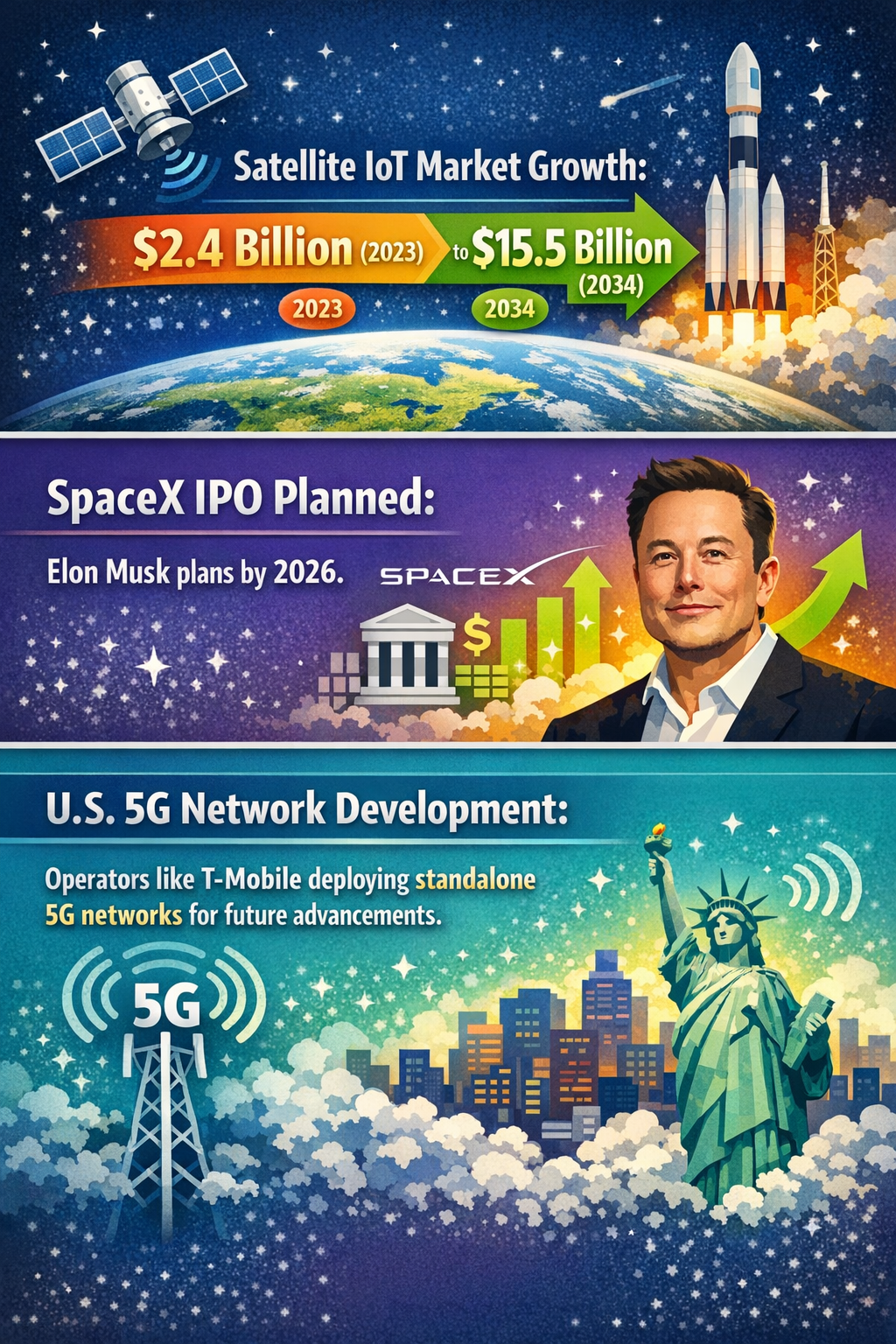
Moreover, the integration between satellite and cellular technologies will usher in a more resilient, pervasive network landscape. Efforts to fuse satellite connectivity with evolving 5G/6G standards could reduce the unit costs of satellite terminals dramatically—potentially below $10,000 by 2028—enabling mass-market adoption and new business models (Yahoo Finance, 2026). The ongoing rollout of 5G standalone networks that offer fully independent cellular infrastructure signals readiness to embrace outside satellite links to enhance coverage, especially in rural and underserved regions (Ookla, 2026).
A geopolitical dimension is also emerging as demonstrated by Ukraine’s use of Starlink terminals to disrupt Russian military drone strikes, showing how satellite-enabled connectivity can become a force multiplier in asymmetric warfare, while adversaries seek fallback communication options such as analog radio (Critical Threats, 2026). This intersection highlights how satellite-5G integration might impact not only commercial but also national security ecosystems more deeply.
Why is this Important?
The progressive integration of satellite and 5G networks has profound ramifications for connectivity and industry innovation. Where terrestrial 5G deployment often struggles with geographic and economic limitations, satellite links could fill the gaps, ensuring consistent service in remote areas or regions hit by disasters. This could unlock new markets for IoT deployments in agriculture, logistics, smart cities, and healthcare, amplifying the socioeconomic benefits of connected technologies on a global scale.
Enterprises stand to gain from enhanced network resiliency and diversity. Satellite-enabled 5G might provide critical fallback options for data centers and industry facilities aiming to maintain uptime when terrestrial links falter. In IoT ecosystems, embedding connectivity with eSIMs that can remotely provision subscriber identity strengthens device security and lifecycle management, which remains a weak link in many current deployments.
The reduced cost of satellite terminals combined with enhanced cellular integration can transform business models from niche satellite users toward mainstream enterprises and consumers. This may accelerate the adoption of hybrid connectivity models blending satellite and terrestrial signals for optimal reliability and coverage.
From a technology perspective, the fuse of satellite and 5G could spur innovations in network management, edge computing, and AI-driven optimization across sectors. The anticipation of tens of millions of jobs supported by 5G and a $13 trillion contribution to the global economy by 2035 (PA Global, 2026) suggests satellite augmentation might add materially to this growth trajectory rather than compete with it.
Finally, the security and geopolitical implications are critical. Satellite-5G interoperability will demand robust cybersecurity frameworks to protect against disruptions, espionage, or sabotage, especially in sensitive government or military uses. Regulatory and policy coordination will also be essential to manage spectrum allocation and cross-border data flows amid increasing satellite constellation deployments.
Implications
Businesses, governments, and technology providers must prepare for a progressively integrated satellite and 5G ecosystem that is likely to redefine connectivity norms and value chains. Key considerations include:
- Investment in hybrid network capabilities: Organizations should evaluate network architectures that combine satellite and terrestrial links to maximize coverage, reliability, and latency performance for critical applications.
- Development of security frameworks: Strong cybersecurity mechanisms, including Remote SIM Provisioning and eSIM lifecycle management, must be standard to protect diverse IoT and enterprise deployments from emerging threats.
- Strategic partnerships: Collaborations between satellite operators, mobile network providers, cloud platforms, and enterprise IT vendors will be pivotal to creating seamless services and unlocking new market opportunities.
- Regulatory engagement: Policymakers will need to balance innovation with spectrum management, data sovereignty, and security concerns to foster sustainable ecosystem growth.
- Workforce readiness: To realize the potential of 5G-satellite integration, workforce training in cross-domain telecommunications, cybersecurity, and data management will be critical.
Anticipating this transformative shift enables stakeholders to position themselves advantageously in upcoming technology waves and market expansions. Ignoring the rising complementarity between satellite and 5G infrastructure could leave organizations vulnerable to connectivity disruptions, lost competitive advantage, or missed growth avenues.
Questions
- How can enterprises integrate satellite-enabled 5G solutions within existing network strategies to improve resilience without excessive cost or complexity?
- What cybersecurity measures must be prioritized for seamless and secure satellite-cellular IoT connectivity, especially given the reliance on eSIM and Remote SIM Provisioning?
- Which industries stand to benefit most from satellite-5G integration, and how can new service models be developed to address their specific connectivity challenges?
- What regulatory frameworks and international coordination mechanisms are necessary to support the growing number of satellite constellations interlinked with terrestrial 5G networks?
- How might geopolitical risks influence the deployment and management of satellite-enabled communications within civilian and military domains?
- What role could edge computing and AI play in optimizing hybrid satellite-5G networks in latency-sensitive or bandwidth-constrained contexts?
Keywords
Satellite communications; 5G; Satellite integration; Direct-to-Cell; Remote SIM Provisioning; eSIM; Industrial IoT; Network security; Hybrid networks; Geopolitical risk
Bibliography
- The expected ramp-up of Starlink v3, enabled by Starship, marks a step change in per-satellite capacity and payload concentration.
- SpaceX plans to deploy tens of thousands of Direct-to-Cell-equipped Starlink satellites over the coming years, expanding SMS capability and gradually introducing low-speed data services.
- In collaboration with CSPs and other global partners, Microsoft and Ericsson will deliver enterprise 5G bundles.
- At MWC 2026, focus on satellite-enabled usage scenarios including industrial IoT, automotive connectivity, and private networks.
- Remote SIM Provisioning and eSIM architecture essential for cellular IoT security.
- Reducing satellite terminal unit costs below $10,000 by 2028 and integration with 5G/6G networks.
- Ukraine’s and SpaceX’s efforts affecting Russian military drone operations via Starlink disruptions.
- U.S. operators positioning standalone 5G networks for future advanced 5G capabilities.
- By 2035, 5G supporting millions of jobs and contributing trillions to the global economy.