
The Rise of Comprehensive Financial Asset Tokenization: A Subtle Disruption on the Horizon
Financial markets may be on the cusp of a significant transformation driven by an evolving yet underappreciated trend: the near-complete tokenization of traditional financial assets. Once confined to niche blockchain experiments, tokenized assets—digital representations of real-world assets on a blockchain—are beginning to expand beyond initial stablecoins and tokenized treasuries into almost all asset classes. This weak signal of the digitalization and fragmentation of value could disrupt multiple industries by reshaping liquidity, regulatory frameworks, and institutional adoption in the next decade.
What’s Changing?
The landscape of digital assets is entering a phase where tokenization accelerates beyond mere experimentation into mainstream financial infrastructure. Central banks and governments have already begun stepping into this space with pilot and live projects around Central Bank Digital Currencies (CBDCs). The European Central Bank, for instance, is actively developing a digital euro, expected to launch within the next few years, while countries such as Nigeria and the Bahamas have already deployed live CBDC systems (Source: Blockchain Technology Trends in 2026).
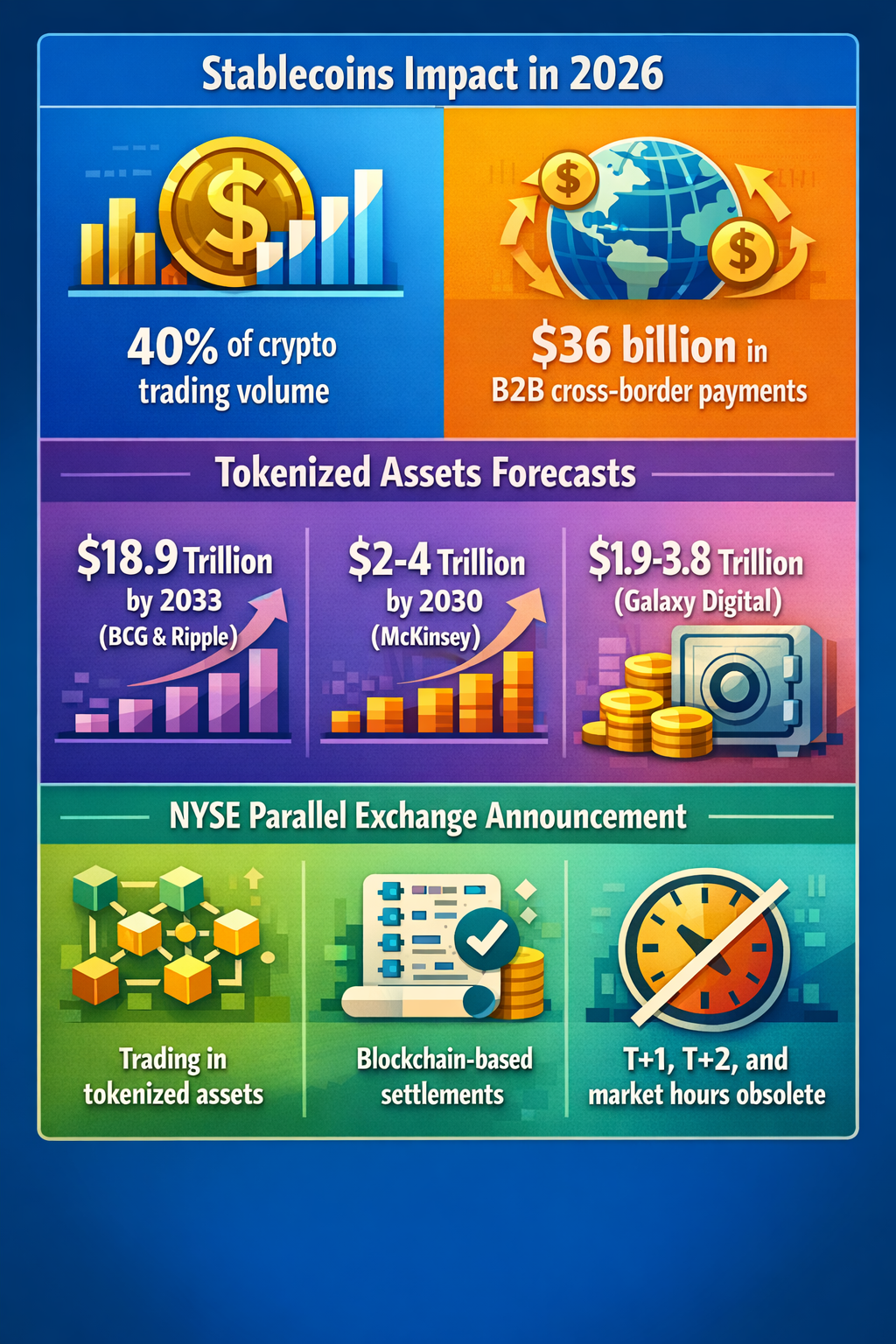
This CBDC adoption creates a critical foundation upon which other digital financial innovations build. Alongside CBDCs, tokenization powered by stablecoins—a class of cryptocurrencies pegged to traditional currencies or assets—has witnessed explosive growth. In 2026, stablecoins reportedly made up 40% of crypto trading volume, facilitating approximately $36 billion in business-to-business cross-border payments annually (Source: Critical Crypto Security Infrastructure 2026).
More significantly, the tokenization of traditionally illiquid assets, such as real estate, collectibles, or private equity stakes, is gaining momentum. This movement is catalyzed by the convergence of blockchain technology with cryptocurrencies’ stability and regulatory clarity. It is anticipated that by 2026, pure speculation will no longer dominate the crypto space; instead, a substantive focus on real-world asset tokenization will take precedence (Source: Institutional Digital Asset Adoption Hits New 2026 Peaks).
Wall Street giants like JPMorgan are adopting a constructive tone on crypto markets, signaling the importance of institutional inflows and anticipated regulatory frameworks that could support the next growth leg in digital assets (Source: JPMorgan Bullish on Crypto for Rest of Year).
Furthermore, fintech analysis points toward a future where nearly every financial asset class might be tokenized over the next decade, implying a fundamental shift in asset ownership, tradability, and market structure (Source: The State of Fintech in 2026).
Why is This Important?
The comprehensive tokenization of financial assets could reshape capital markets on multiple fronts. First, tokenized assets can reduce friction by enabling fractional ownership, opening up investments to broader audiences and enhancing liquidity for assets previously considered illiquid or accessible exclusively to elite investors. This democratization could create new pathways for funding, wealth building, and inclusive economic participation across sectors and geographies.
Second, traditional financial intermediaries, including brokers, custodians, and clearing houses, may face pressure to adapt or risk obsolescence. Tokenization automates settlement and clearing through blockchain’s inherent transparency and security features, potentially truncating traditional, cumbersome processes. Institutions that position themselves to integrate tokenization infrastructure may unlock efficiencies and competitive advantages.
Third, regulatory ecosystems will need to evolve rapidly to keep pace with tokenized assets. The dual challenge of encouraging innovation while preventing misuse—such as money laundering or consumer fraud—requires nuanced policy frameworks. The increasing institutional interest, including from established banks and policymakers, suggests regulations may become clearer and more favorable, simultaneously expanding market participation and public trust.
Finally, cross-border financial transactions stand to benefit from faster settlement, reduced costs, and improved transparency, driven by stablecoins and CBDCs. This could disrupt current correspondent banking models and have broader implications for international trade finance, remittances, and monetary policy implementation.
Implications
Businesses across finance and non-finance sectors should prepare for a gradual but profound shift toward digital asset tokenization. Key considerations include:
- Strategic Integration: Companies in asset management, banking, and payments must evaluate how tokenization can integrate into their existing products and services. Early investment in blockchain infrastructure and partnerships could provide first-mover advantages.
- Operational Transformation: Tokenization could reduce settlement times from days to minutes or seconds. Organizations should redesign internal controls, risk assessment, and compliance frameworks to address these new dynamics.
- Regulatory Engagement: Firms should proactively engage with regulators and industry bodies to shape policies that allow innovation without compromising security. Keeping abreast of cross-jurisdictional developments is critical as CBDCs and stablecoins operate globally.
- Market Expansion: Tokenized assets permit fractional and programmable ownership structures. This could create new financial products and markets catering to smaller investors, enhancing inclusion and expanding customer bases.
- Security and Custodianship: As ownership shifts to digital tokens, the importance of secure custody solutions, including institutional-grade wallets and smart contract audits, will grow markedly. Firms need to elevate cybersecurity postures to mitigate novel threats.
The upheaval is not limited to finance. Real estate, art, commodities, and even intellectual property rights could adopt tokenization, thereby blurring industry boundaries and fostering new business models. Organizations that understand tokenization’s technical and regulatory nuances will be better positioned to identify and leverage emergent opportunities.
Questions
- Which traditional asset classes in your portfolio or industry could benefit most from fractional ownership enabled by tokenization?
- How mature are your organization’s technological capabilities and partnerships to support blockchain-based asset management?
- What frameworks and safeguards do you currently have in place to address regulatory compliance and digital asset security risks?
- How might tokenization alter your existing business partnerships, competitive landscape, and customer engagement strategies?
- Are policy-makers and industry consortia you engage with ready to support and shape the transition toward tokenized assets?
Keywords
financial asset tokenization; central bank digital currency (CBDC); stablecoins; blockchain; tokenization; digital assets; asset management; regulation
Bibliography
- Blockchain Technology Trends in 2026. Mobile App Development Company. https://www.mobileappdevelopmentcompany.us/blog/blockchain-technology-trends-in-2026/
- Tokenization Accelerates, Powered by Stablecoins In 2026. Ryan & Wetmore. https://www.ryanandwetmore.com/insights/2026-asset-management-trends-digital-assets-ai?hs_amp=true
- Australian Financial Infrastructure Expands as Institutional Digital Asset Adoption Hits New 2026 Peaks. Proactive Investors. https://www.proactiveinvestors.com/companies/news/1087121/australian-financial-infrastructure-expands-as-institutional-digital-asset-adoption-hits-new-2026-peaks-1087121.html
- JPMorgan Bullish on Crypto for Rest of Year as Institutional Flows Set to Drive Recovery. CoinDesk. https://www.coindesk.com/markets/2026/02/11/jpmorgan-bullish-on-crypto-for-rest-of-year-as-institutional-flows-set-to-drive-recovery
- The State of Fintech in 2026. Fintech Prime Time. https://fintechprimetime.substack.com/p/the-state-of-fintech-in-2026
- Critical Crypto Security Infrastructure 2026. AInvest. https://www.ainvest.com/news/critical-crypto-security-infrastructure-2026-2601/