
AI-Driven Network Orchestration as a Hidden Inflection in Connectivity’s Evolution
The convergence of artificial intelligence (AI) with next-generation network architectures is widely recognized as a critical enabler for 5G and future 6G connectivity. However, embedded within this integration is a less-observed but potentially transformative inflection: the shift toward fully AI-native, autonomous network orchestration systems capable of real-time, microsecond-level decision-making across distributed radio access networks (RAN) and cloud infrastructure. This development goes beyond incremental efficiency gains or incremental capacity increases; it poses a plausible foundation for structurally reconfiguring industrial value chains, capital investment priorities, and regulatory oversight within the telecommunications and digital infrastructure landscape over the next 5–20 years.
Signal Identification
The identified development qualifies as an emerging inflection indicator rather than a mere trend or weak signal because it reflects a fundamental change in how network capabilities might be engineered, managed, and optimized at scale. Artificial Intelligence Radio Access Networks (AI-RAN), highlighted in Nokia’s commitment to commercial deployments by 2027 in partnership with Nvidia (Ookla, 2026), embody a new class of network architecture that requires AI systems to conduct autonomous microsecond-level decisions for antenna coordination and massive Multiple Input Multiple Output (MIMO) optimization (CrispIdea, 2026). This is not just an evolutionary step from 5G to 5G-Advanced or 6G; it is a structural re-imagining of the connectivity fabric itself. The plausible time horizon for scaling such systems is medium-term (5–10 years), with medium to high plausibility given ongoing trials and investments. Sectors exposed include telecommunications, network hardware manufacturing, semiconductor industries, enterprise infrastructure, cloud providers, and regulatory bodies responsible for spectrum management and network governance.
What Is Changing
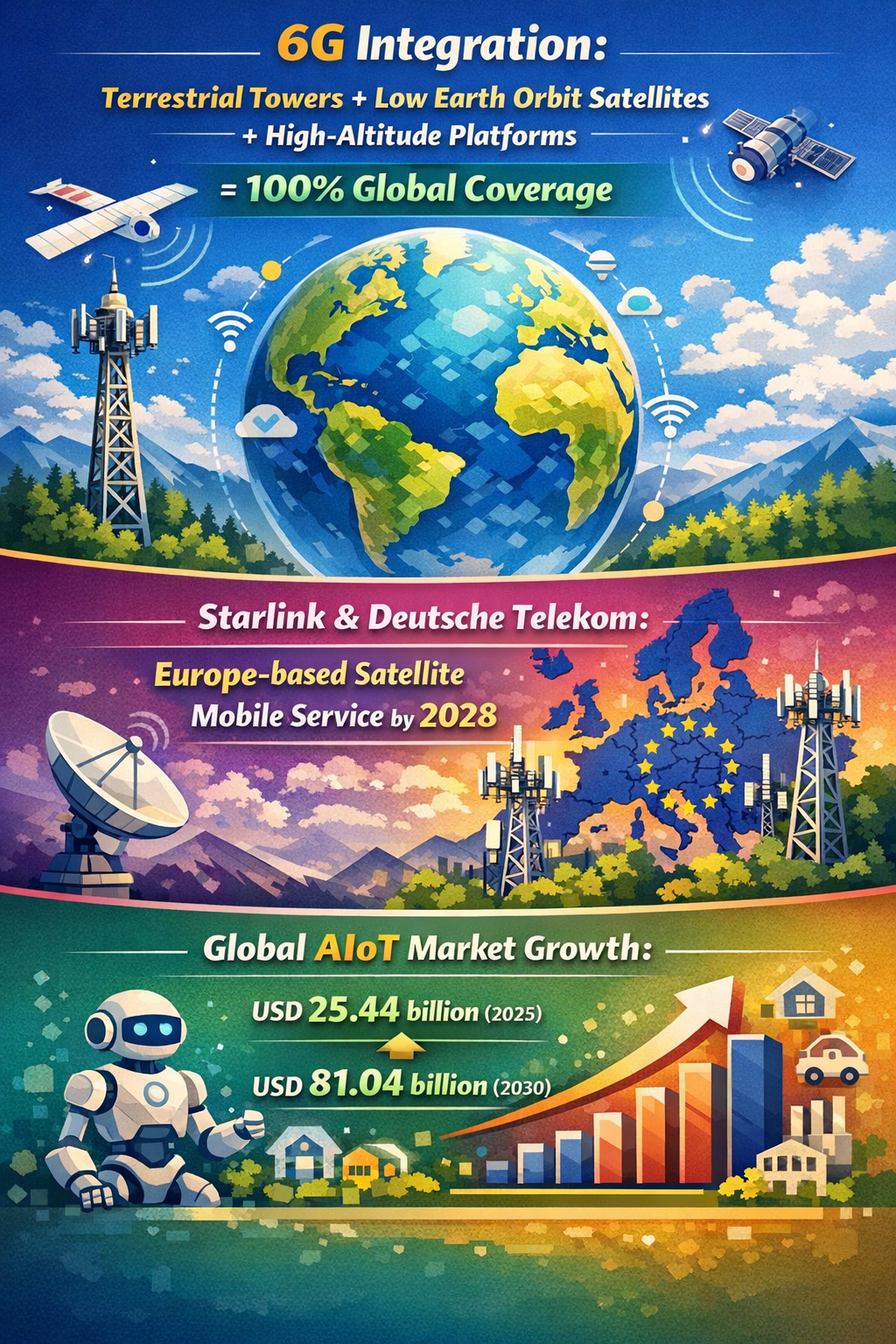
The reviewed articles collectively identify an era of unprecedented connectivity growth: over 5.5 billion 5G connections by 2030 (AIPix, 2026), an explosion in Internet of Things (IoT) endpoints surpassing 32 billion by the same horizon (KaaIoT, 2026), and initial 6G deployments starting near decade’s end (TechNexus, 2026). Within this volume growth, a less emphasized yet critical shift is toward AI-native network management. This shift extends beyond adding AI capabilities as mere analytic tools or operational aids; it institutionalizes AI as the core driver of real-time network orchestration.
The AI-RAN concept incorporates NVIDIA’s AI accelerators and Nokia’s radio technology to embed decision-making algorithms within the network fabric itself, enabling microsecond-level adaptations. This real-time orchestration optimizes spectrum use, power consumption, and signal paths dynamically – a marked departure from static or semi-static configurations previously employed.
Concurrently, the semiconductor industry is co-evolving, producing chips tailored for AI-native workloads in connectivity environments, reinforcing the physical and logical co-dependency of AI and network infrastructure (CrispIdea, 2026). This signals a structural pivot in supplier relationships and value creation zones within the telecommunications ecosystem.
Disruption Pathway
The evolution of AI-native network orchestration could initiate structural change starting with incremental deployment within leading enterprise and urban infrastructure markets, where dense IoT instrumentation demands high-performance management. Early success in AI-RAN systems will demonstrate operational efficiencies and cost reductions, creating competitive pressure on incumbent network operators to adopt similar architectures or risk obsolescence.
Amplifiers of this inflection will include: increased availability of AI-optimized semiconductor hardware; maturation of low-latency cloud-edge frameworks; and regulatory relaxation or modernization that accommodates AI-based automated frequency allocation and interference mitigation. Conversely, geopolitical tensions around data sovereignty and spectrum allocation may accelerate localized network autonomy, further incentivizing distributed AI orchestration.
The upstream supply chain will feel pronounced disruption. Traditional equipment manufacturers may be marginalized if unable to integrate AI silicon capabilities effectively, while new entrants rooted in AI chipset design and software-defined infrastructure gain industrial prominence. Capital allocation in the industry could pivot rapidly, favoring companies that deliver AI-native embedded networking hardware and specialized AI orchestration platforms.
On the regulatory front, the move to autonomous network management challenges existing spectrum licensing regimes and network reliability certifications predicated on human intervention and static configurations. Regulators may have to invent new accountability frameworks for AI decision-making in critical communication infrastructure, encompassing transparency, auditability, and liability assignment. This could overhaul governance models for connectivity assets, particularly in sectors like public safety, transportation, and finance that rely on predictable network behavior.
Why This Matters
From a capital allocation perspective, failing to identify and invest in AI-native network orchestration capabilities may expose operators and infrastructure investors to competitive displacement and stranded asset risk as AI-driven architectures demonstrate superior cost-performance profiles. Telecommunications vendors and semiconductor firms are positioned differently based on their AI integration roadmaps, affecting valuation and M&A activity.
Regulators face complex challenges in anticipating this shift. Legacy policy frameworks may inadequately address autonomous decision systems embedded in critical infrastructure, potentially delaying safe deployment or, conversely, leaving gaps exploitable by bad actors or unintended systemic risks.
Strategic positioning must also consider the emerging oligopoly of AI hardware-software providers that may commoditize traditional network service offerings through embedded AI-enabled efficiencies. Enterprises depending on bespoke network services or verticalized IoT applications could gain leverage by advocating for open AI orchestration standards to avoid vendor lock-in.
Implications
This inflection could plausibly restructure how networks are built, managed, and regulated across connected infrastructure. It may lead to new capital flows favoring AI-native semiconductor development and software-defined networking platforms. Regulatory regimes may evolve from prescription and oversight of static networks toward continuous AI system validation and trust frameworks.
However, this signal should not be conflated with the general hype around 6G or IoT volumes per se. The true disruption lies in the orchestration AI’s autonomous control capabilities rather than mere network speed or endpoint proliferation. Moreover, competing interpretations exist around how quickly regulatory regimes will adapt or whether legacy vendors can themselves develop integrated AI capabilities to blunt new entrants’ advantages.
Early Indicators to Monitor
- Surge in patent filings related to AI-driven network orchestration, specifically microsecond-level decision algorithms - Procurement announcements from major mobile network operators for AI-RAN pilot projects or full deployments - Public-private partnerships or consortia forming around AI-based spectrum management or autonomous network governance standards - Venture capital clusters investing in niche startups combining AI hardware design with telecom software stacks - Initial regulatory consultations or white papers discussing AI accountability frameworks in critical communications infrastructure
Disconfirming Signals
- Delay or cancellation of AI-RAN commercial rollout commitments - Regulatory frameworks imposing prohibitive constraints or moratoria on AI-driven network management systems - Lack of adoption or disinterest from major telecommunications operators post-pilot phase - Emergence of alternative architectures focusing on quantum or radically different physical layer technologies that bypass AI orchestration complexities - Persistent performance or security failures within AI-native systems deterring scale-up
Strategic Questions
- How prepared is our organization to integrate AI-native orchestration capabilities into existing network assets and operational processes?
- What are the emerging regulatory signals around autonomous AI systems in telecommunications infrastructure, and how might they evolve?
- Which ecosystem partners—chip suppliers, software vendors, standards bodies—should be prioritized given this structural shift?
- How can capital allocation be balanced between incremental network upgrades versus investments in AI-native platforms that may disrupt current business models?
- What governance and risk frameworks must be developed to ensure accountability and resilience for autonomous network decision systems?
- What scenarios might accelerate or inhibit adoption of AI-RAN, and how should contingency strategies reflect these potential inflection pathways?
Keywords
Artificial Intelligence; AI-RAN; 6G; Network Orchestration; Telecommunications; Semiconductors; IoT; Autonomous Systems; Regulation; Spectrum Management.
Bibliography
- KaaIoT, 5 IoT Trends Defining Smart Infrastructure in 2026 (2026)
- Ookla, MWC 2026 Wrap-Up: The Analyst Take on Satellite, 6G, Sovereignty, and AI (2026)
- TechNexus, MWC 2026 Highlights: 50 Announcements on AI Networks, 5G NTN, Connected Enterprises (2026)
- CrispIdea, AI in Semiconductor Industry 2026 (2026)
- AIPix, Telecommunications Industry Growth Projections 2026–2030 for Operators and ISPs (2026)