
Urban Aerial Mobility as a Latent Structural Lever in Megacity Evolution
Urbanization and megacity growth are converging with emerging advanced air mobility (AAM) ecosystems, yet a critical weak signal lies in the systemic integration of urban air taxis with multimodal smart city networks. This latent development could reshape urban transport architectures, regulatory frameworks, and capital allocation strategies globally over the next two decades.
Although air taxi services frequently appear as incremental transit supplements in urban plans, their embedding within comprehensive multimodal mobility and smart city visions remains underappreciated. Early deployments, especially in Asia-Pacific and Gulf Cooperation Council (GCC) regions, illustrate emerging infrastructural and regulatory inflections that may cascade into complex urban ecosystem transformations. Recognizing this integrative dimension is essential for senior decision-makers navigating long-term strategic positioning in urban infrastructure, regulatory design, and industrial innovation.
Signal Identification
This is classified as an emerging inflection indicator because it signals not merely technological adoption but a systemic shift toward embedding air taxis within multimodal, IoT-enabled smart city frameworks. Unlike isolated pilot projects or standalone air mobility ventures, this trend is discernible through coordinated planning efforts integrating electric vertical takeoff and landing (eVTOL) aircraft with metro, rail, micro-mobility, and digital infrastructure. The time horizon is 10–20 years, given technology maturation and city-scale deployment phases. Plausibility is high due to current investments and policy momentum.
Sectors exposed include urban mobility, aviation, infrastructure, telecommunications (notably 5G and Internet of Things (IoT)), real estate development, and regulatory bodies shaping airspace governance and city planning.
What Is Changing
Rapid urbanization in Asia-Pacific, driven by surging disposable incomes and increasing investments in electric and autonomous vehicles, also propels demand for novel mobility solutions (Precedence Research 15/05/2024). Air taxi services are transcending boutique experiments and being envisaged as integral components of multimodal transport ecosystems. In the UK and Taiwan, urban air taxis are being planned in conjunction with conventional transport modes such as metro, bus, rail, and micro-mobility networks, signaling a strategic shift toward interoperability rather than siloed deployment (Mobility Foresights 01/04/2024; Mobility Foresights 01/04/2024).
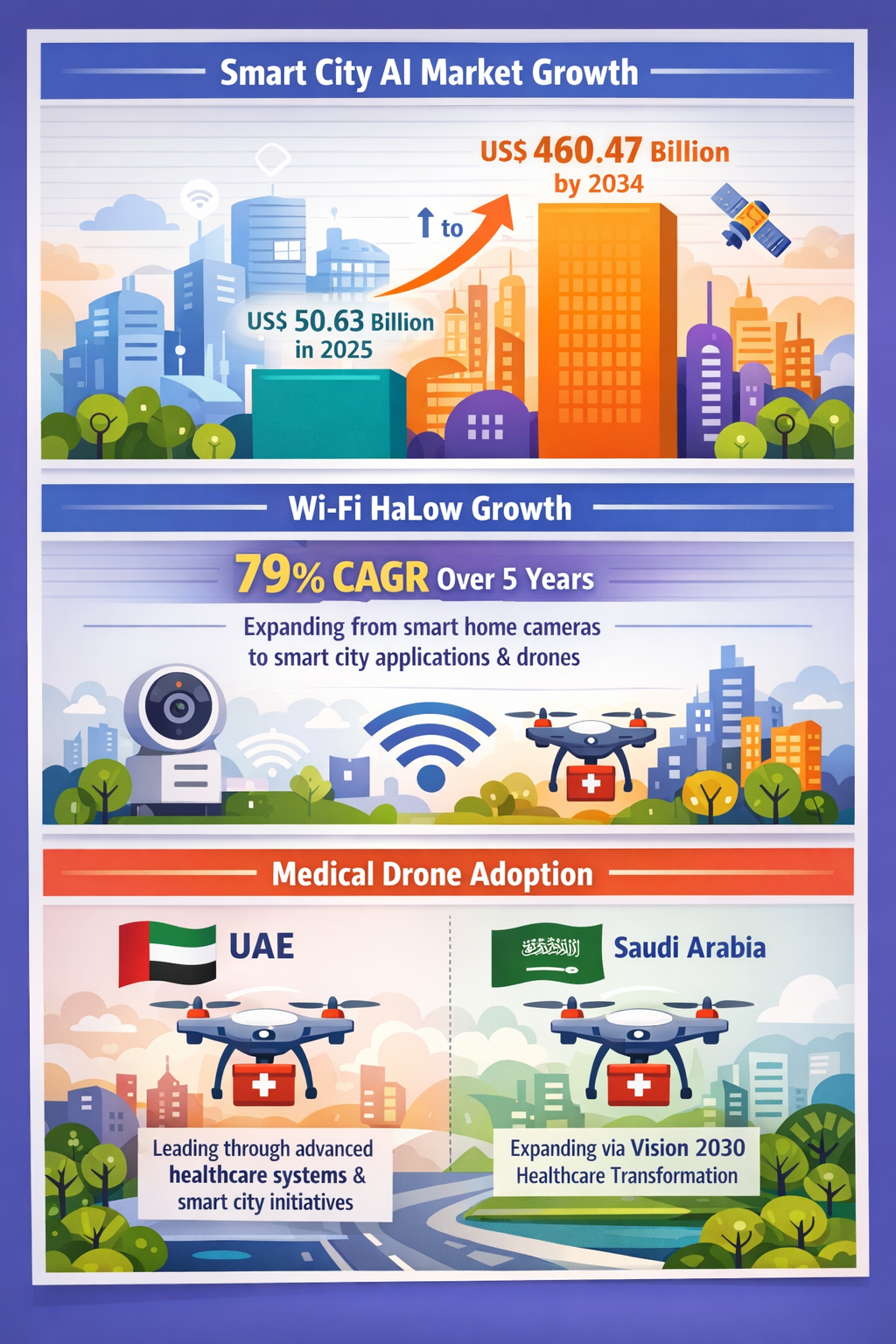
Parallel to these transport developments, GCC countries, notably the UAE and Saudi Arabia, are aggressively implementing IoT-driven smart city projects leveraging 5G connectivity, aiming to optimize resource usage and operational efficiency in retail, healthcare, and logistics (Precedence Research 12/05/2024; Stratrich 15/04/2024). Dubai’s smart city evolution underscores autonomy and interoperability as foundational principles (WDCS Technology 20/03/2024).
The investment surge in electric aircraft, together with cold-chain infrastructure expansion in Asia-Pacific, reflects an industrial enthusiasm aligned with both urban growth and advanced air mobility capabilities (Persistence Market Research 27/03/2024; GlobeNewswire 30/03/2026).
Collectively, these developments emphasize a qualitatively new structural theme: the convergence of aerial mobility and multimodal urban transport under digitally interconnected governance and infrastructure frameworks. This is not just new mobility but represents an embryonic ecosystem combining airspace management, integrated ticketing, real-time data exchange, and platform interoperability—a systemically different urban transport architecture.
Disruption Pathway
The evolution begins as incremental pilots and municipal smart city projects demonstrate pilot integrations of air taxis with existing transport modes. Successes in operational efficiency, congestion relief, and modal shift incentives could catalyse further municipal and national regulatory investments in dedicated vertiports, air traffic management systems, and standardized interoperability protocols. Integration with 5G IoT platforms will enable dynamic fleet management, real-time re-routing, and seamless passenger transitions between transit modes.
As urban populations swell, traditional ground transport networks will continue facing capacity and emission pressures, magnifying incentives to adopt aerial solutions that deliver above-ground congestion relief. This systemic stress could push regulators to re-examine airspace governance frameworks, safety standards, and zoning laws, potentially relaxing regulatory barriers that today inhibit expansive air taxi operations.
Capital allocation could increasingly favor transmodal infrastructure projects combining aerial and terrestrial transport capabilities, displacing investments from traditional road or rail-only projects. This reorientation may spur new industrial alliances bridging aerospace, telecom, urban planning, and mobility services, reshaping supplier and operator ecosystems.
Unintended consequences may include emergent airspace inequities, noise pollution conflicts, or cybersecurity vulnerabilities inherent to complex IoT dependencies, prompting adaptive governance models that enforce equitable access and resilience standards. Feedback loops may arise whereby successful urban aerial mobility drives population densification patterns supporting vertical growth and new real estate typologies integrating vertiport infrastructure.
In this ecosystem, incumbent regulatory and industrial paradigms centered on separate transport modalities may give way to integrated frameworks and new controls over dynamic urban airspace allocation and management.
Why This Matters
Decision-makers face exposure across capital deployment choices in urban transport infrastructure, digital network expansion, and aerospace manufacturing. Early recognition of the systemic integration of aerial mobility with smart city infrastructure can guide more efficient allocation of public resources and incentivize private investment to align with emergent urban ecosystem configurations.
Regulatory bodies will need to anticipate cross-sectoral governance adjustments encompassing airspace management, urban zoning, IoT security, data privacy, and transport interoperability. Competitive positioning within the mobility and aerospace sectors may shift as new ecosystem entrants, including technology firms and integrated operators, challenge traditional aerospace incumbents focused on standalone aircraft manufacturing or services.
Supply chains could see increasing interdependencies between telecom infrastructure providers, electric aircraft systems, micro-mobility manufacturers, and city planners. Liability and governance frameworks must evolve to address multi-modal operational risks and data governance challenges inherent in integrated transport platforms.
Implications
This signal may scale into structural change by catalyzing a new integrated urban mobility model where air taxis become a routine, interoperable element of daily transit rather than niche novelties. It could shift capital from conventional road and rail infrastructure toward layered mobility architectures that include aerial corridors, vertiports, and IoT management systems. Regulatory regimes may increasingly emphasize federated, cross-sectoral frameworks addressing airspace as an urban commons.
This development is not simply about air taxi technology adoption or hype around vertical lift vehicles. Nor is it a marginal upgrade to urban transit. The critical factor is the systemic integration within multimodal smart city infrastructures enabling scalable operational models.
Competing interpretations might argue that infrastructure costs, regulatory inertia, or social acceptance will constrain air mobility integration. However, evidence of coordinated planning and investment in Asia-Pacific and Gulf regions suggests these barriers may be surmountable, shifting this signal closer to mainstream structural change.
Early Indicators to Monitor
- Municipal and national policy documents explicitly integrating air taxis with urban transit master plans
- Public and private capital reallocations toward multi-modal infrastructure projects combining aerial and terrestrial transport
- Joint ventures and partnerships between aerospace manufacturers, telecom providers, and urban transit authorities
- Standards development and regulatory drafts for urban airspace management and intermodal data interoperability
- IoT platform deployments in pilot cities that synchronize air taxi operations with ground mobility networks
Disconfirming Signals
- Significant safety incidents or technical failures undermining trust in air taxi viability
- Regulatory clampdowns or moratoria on urban airspace use for passenger transport
- Stagnation or rollback in IoT or 5G infrastructure expansion critical for real-time integration
- Deterioration of political will or capital investment toward multi-modal smart city transport integration
- Public resistance to noise, privacy, or airspace utilization impeding deployment
Strategic Questions
- How should capital allocation strategies adapt to prioritize integrative transport infrastructure over mode-specific investments?
- What regulatory frameworks are necessary to coordinate urban airspace governance with ground mobility and digital infrastructure?
Keywords
Urban Air Mobility; Multimodal Transport; Smart Cities; Electric Vertical Takeoff and Landing; IoT Integration; 5G Connectivity; Urban Airspace Governance; Advanced Air Mobility Market; Aerospace Regulation
Bibliography
- Integration with Multimodal Mobility and Smart City Plans Air taxi services are increasingly being envisioned as components of broader multimodal urban mobility plans integrated with metro, bus, rail, and micro-mobility networks in UK. Mobility Foresights. Published 01/04/2024.
- Integration with Multimodal Mobility and Smart City Plans Air taxi services are increasingly being envisioned as components of broader multimodal urban mobility plans integrated with metro, bus, rail, and micro-mobility networks in Taiwan. Mobility Foresights. Published 01/04/2024.
- Asia Pacific is expected to grow rapidly with a CAGR of 20.5% throughout the forecast period, fueled by growing disposable incomes, rapid urbanization, rising vehicle production, and increasing investments in electric and autonomous vehicles. Precedence Research. Published 15/05/2024.
- The Asia Pacific region is expected to experience the fastest CAGR of 25.67% during the forecast period, driven by factors such as rapid urbanization, increased investment in electric aircraft, and the rise of smart cities. GlobeNewswire. Published 30/03/2026.
- Dubai's next phase of smart city evolution will be defined by autonomy and interoperability. WDCS Technology. Published 20/03/2024.