
Low Earth Orbit (LEO) Satellite Direct-to-Device (D2D) Networks: A Silent Structural Disruptor in Global Connectivity
Emerging LEO satellite constellations delivering direct-to-device (D2D) communications represent a nascent but potentially transformative shift in global connectivity infrastructure. This weak signal could disintermediate terrestrial mobile network operators, reshape regulatory frameworks around spectrum and space governance, and reconfigure capital allocation patterns in telecommunications over the next decade.
The convergence of advanced LEO mega-constellations by incumbents and new entrants—such as SpaceX’s Starlink and Amazon’s Globalstar acquisition—coupled with accelerating 5G integration and the emerging 6G vision for machine-centric networks, signals a latent inflection point. This development may crystallize into a structurally distinct vertical communications infrastructure that enables ubiquitous, seamless connectivity without terrestrial intermediaries.
Signal Identification
This development qualifies as a weak signal with emerging inflection characteristics. While widely covered in industry news, the disruptive potential of LEO satellite D2D services is underappreciated in strategic foresight communities and remains outside the core horizon of conventional mobile network expansion debates. It has a medium to high plausibility horizon within 5–10 years, as initial deployments and network scaling are forecast by 2026–2028 (Ookla 27/04/2026). The sectors exposed include telecommunications, aerospace, industrial automation, regulatory bodies overseeing spectrum, and capital markets investing in network infrastructure.
What Is Changing
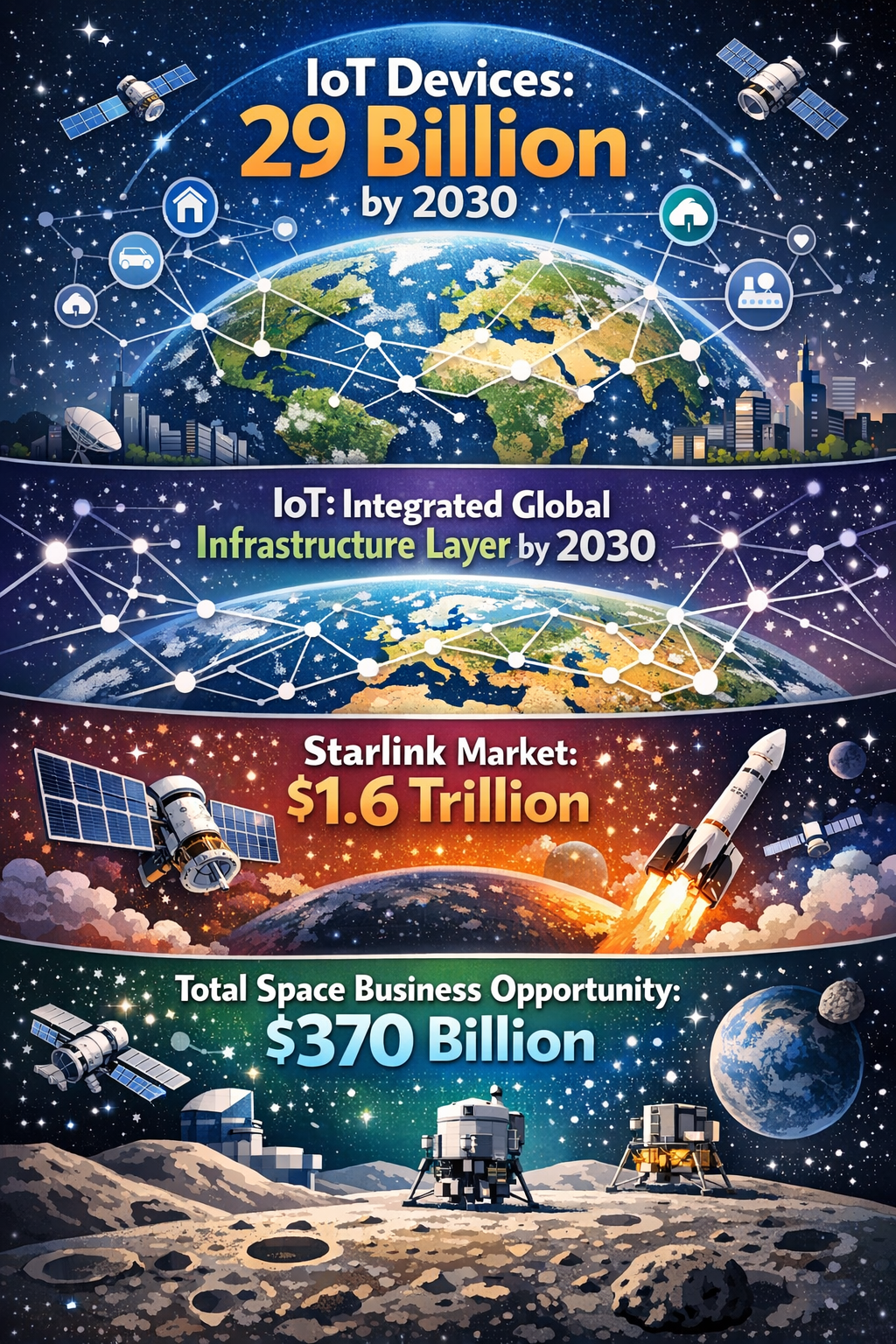
Multiple recent developments highlight an acceleration towards LEO satellite-based D2D connectivity as a credible alternative or complement to terrestrial networks. Starlink’s promises on its version 2 (V2) constellation envisage mobile network operators (MNOs) potentially reducing terrestrial investment by adopting satellite-enabled services to reach unserved or underserved regions (Ookla 27/04/2026). Concurrently, Amazon’s $11.5 billion acquisition of Globalstar aims to create a competing LEO mega-constellation, backing a bullish forecast on an $26 billion D2D satellite market (Fieldfisher 13/04/2026). The scale of increase can be inferred from projections estimating over 11 million D2D IoT connections by 2026 and 29 billion total IoT devices by 2030, many likely leveraging this paradigm (Mexico Business News 16/04/2026; IGM Guru 20/04/2026).
A key systemic shift is that 6G is being architected primarily with machines—not humans—as the main users, foreseeing tightly integrated air-space-ground communication layers, including space-based links (StyleTech 22/04/2026). This differs fundamentally from prior generations focusing on terrestrial-centric human connectivity. The implication is an ecosystem where satellite-enabled direct communication supplants or heavily supplements ground infrastructure.
Additionally, current fixed wireless access (FWA) trends show a projected 350 million broadband connections by 2031, 90% of which will rely on 5G technology, reinforcing the broader ecosystem that these satellite systems will enter (PC Tech Mag 01/04/2026). This suggests a hybrid terrestrial-satellite connectivity model is already crystallizing.
What is genuinely under-recognised is that this verticalization of connectivity—where a space-based infrastructure layer directly reaches devices without the need for terrestrial towers or cables—may upend conventional assumptions about network ownership, spectrum regulation, and capital intensity of telecommunications systems.
Disruption Pathway
This latent paradigm shift could evolve structurally over the next decade through several identifiable mechanisms. First, LEO satellite D2D networks may accelerate as early commercial deployments demonstrate cost-competitive, reliable service in remote or industrial environments where deploying terrestrial cells is highly expensive or impractical (Persistence Market Research 10/04/2026). Critical mineral mining operations already deploying 5G underground networks could adopt satellite D2D to connect dispersed IoT sensors and remotely operate machinery, expanding demand and validation.
The scalability of this model benefits from advances in satellite miniaturization and network integration. With companies like SpaceX planning to launch 15,000 V3 satellites enhancing 5G service by 2027 (Next Big Future 15/04/2026), network capacity will grow exponentially, improving latency and data throughput. This could induce a stress on terrestrial operators whose business models rely on expensive spectrum acquisition and dense ground infrastructure.
Regulatory frameworks may be forced to adapt as traditional spectrum allocations become blurred between terrestrial and space-based use. Coordination between space agencies, telecommunication regulators, and international bodies will be required to manage interference, ownership rights, and liability. This may lead to new licensing regimes or international treaty updates, fundamentally changing the governance model for connectivity.
Capital markets could see a reallocation toward integrated satellite-terrestrial players and technology developers enabling this vertical architecture. Incumbents delayed in investing in LEO infrastructure may lose strategic positioning to aggressive newcomers or tech conglomerates consolidating satellite assets, as highlighted by Amazon’s Globalstar bid (Fieldfisher 13/04/2026).
Feedback loops may accelerate adoption as sectors such as mining automation, industrial IoT, and remote first responder communication demand resilient, ubiquitous coverage. This industrial pull could force telecom operators to collaborate or merge with satellite network operators, accelerating ecosystem restructuring.
Why This Matters
For capital allocation, the advancement of D2D satellite networking could redefine investment priorities—shifting budgets away from terrestrial towers and fiber toward satellite deployment and integration technologies. Investors in telecommunications infrastructure, aerospace manufacturing, and IoT hardware may need to reevaluate portfolio risk and growth prospects.
Regulatory agencies face emerging challenges: how to govern spectrum use in an integrated terrestrial-satellite environment, ensure fair competition between satellite and terrestrial operators, and address liability in cross-jurisdictional space operations. Misalignment or lag in regulatory adaptation could either stifle innovation or create governance vacuums increasing systemic risk.
Industry competitive positioning is at stake. Traditional mobile network operators may find their networks bypassed or commoditized, while satellite-enabled providers gain ground in emerging markets and new verticals, especially in automation-heavy industrial sectors such as mining (Persistence Market Research 10/04/2026). Supply chains could be disrupted as satellite manufacturers, launch service providers, and IoT device makers form new alliances, changing procurement priorities.
Liability shifts could emerge in complex service delivery models blending ground and space infrastructure, requiring novel contractual and risk governance frameworks.
Implications
This development may fundamentally shift global connectivity’s industrial structure by creating a vertical integration between satellite network ownership and device connectivity, bypassing traditional mobile networks. It is likely to catalyse new public-private partnerships and multinational regulatory cooperation frameworks, as terrestrial and space intersections grow.
The shift should not be mistaken for mere incremental capacity expansion or niche remote-area coverage solutions. The pattern suggests a systemic platform evolution challenging dominant telecommunications value chains. Competing interpretations exist—some may argue terrestrial 6G alone will suffice or that satellite latency constraints limit large-scale adoption—but expanding evidence of low-latency LEO constellations and their industrial applications weighs in favor of the structural impact scenario.
This signal might also accelerate parallel trends in machine-centric network design envisioned for 6G, deep IoT integration, and remote operation automation, amplifying its ecosystem effects.
Early Indicators to Monitor
- Deployment and operational status of next-generation LEO constellations, including Starlink V3 and Amazon Globalstar satellites.
- Telecom capital expenditures shifting from terrestrial towers to satellite infrastructure and space network integration.
- Regulatory filings and spectrum auctions explicitly addressing satellite-terrestrial coexistence and D2D satellite frequency use.
- Standards bodies advancing air-space-ground integrated network protocols, particularly for 6G architecture.
- Procurement of D2D-capable IoT devices and adoption metrics in high-hazard industrial sectors reliant on remote operations automation.
Disconfirming Signals
- Delays or failures in deploying large-scale operational LEO constellations due to technical or funding constraints.
- Regulatory refusals or international conflicts impeding spectrum sharing and satellite operation authorizations.
- Continued dominance and pricing power consolidation of terrestrial MNOs preventing satellite D2D adoption at scale.
- Persistent latency, security, or reliability issues limiting enterprise and consumer trust in satellite D2D connectivity.
Strategic Questions
- How should telecom operators and investors adjust capital allocation to hedge against potential displacement by satellite D2D networks?
- What regulatory frameworks and international cooperation mechanisms are needed to sustainably govern integrated terrestrial-satellite spectrum and connectivity ecosystems?
Keywords
Low Earth Orbit; Direct-to-Device; LEO Satellite; Satellite Internet; 6G; IoT; Spectrum Regulation; Telecommunications; Connectivity
Bibliography
- Fastest Growing Segment: Tele-Remote Operations is the fastest growing application segment, accelerated by 5G underground network rollouts, IEA-driven critical mineral demand requiring deeper mine access, and regulatory pressure to remove workers from high-hazard underground environments. Persistence Market Research. Published 10/04/2026.
- IoT connections supported by D2D services could reach 11 million in 2026. Mexico Business News. Published 16/04/2026.
- Already Starlink is promising that its V2 constellation for D2D services will allow mobile network operators to invest less in terrestrial networks while unlocking seamless service in remote areas. Ookla. Published 27/04/2026.
- Amazon buys Globalstar in USD 11.5 billion bid to rival Starlink: Amazon has announced its much-anticipated deal to purchase Globalstar to bolster its effort to build a low-earth-orbit satellite business as a rival to Space X's Starlink. Fieldfisher. Published 13/04/2026.
- SpaceX Starlink will upgrade to 15,000 V3 satellites using the increased Echostar bandwidth for 5G service which they plan to start around mid-2027 after getting up the first 2000-4000 of the new V3 DTC satellites. Next Big Future. Published 15/04/2026.
- The mobile industry is working to standardize 6G for deployment from 2030 onward. StyleTech. Published 22/04/2026.
- The number of IoT devices is forecast to exceed 29 billion by 2030. IGM Guru. Published 20/04/2026.
- The Ericsson FWA Outlook forecasts 185 million FWA connections globally by the end of 2025 and 350 million by 2031, with 90% running over 5G. PC Tech Mag. Published 01/04/2026.