
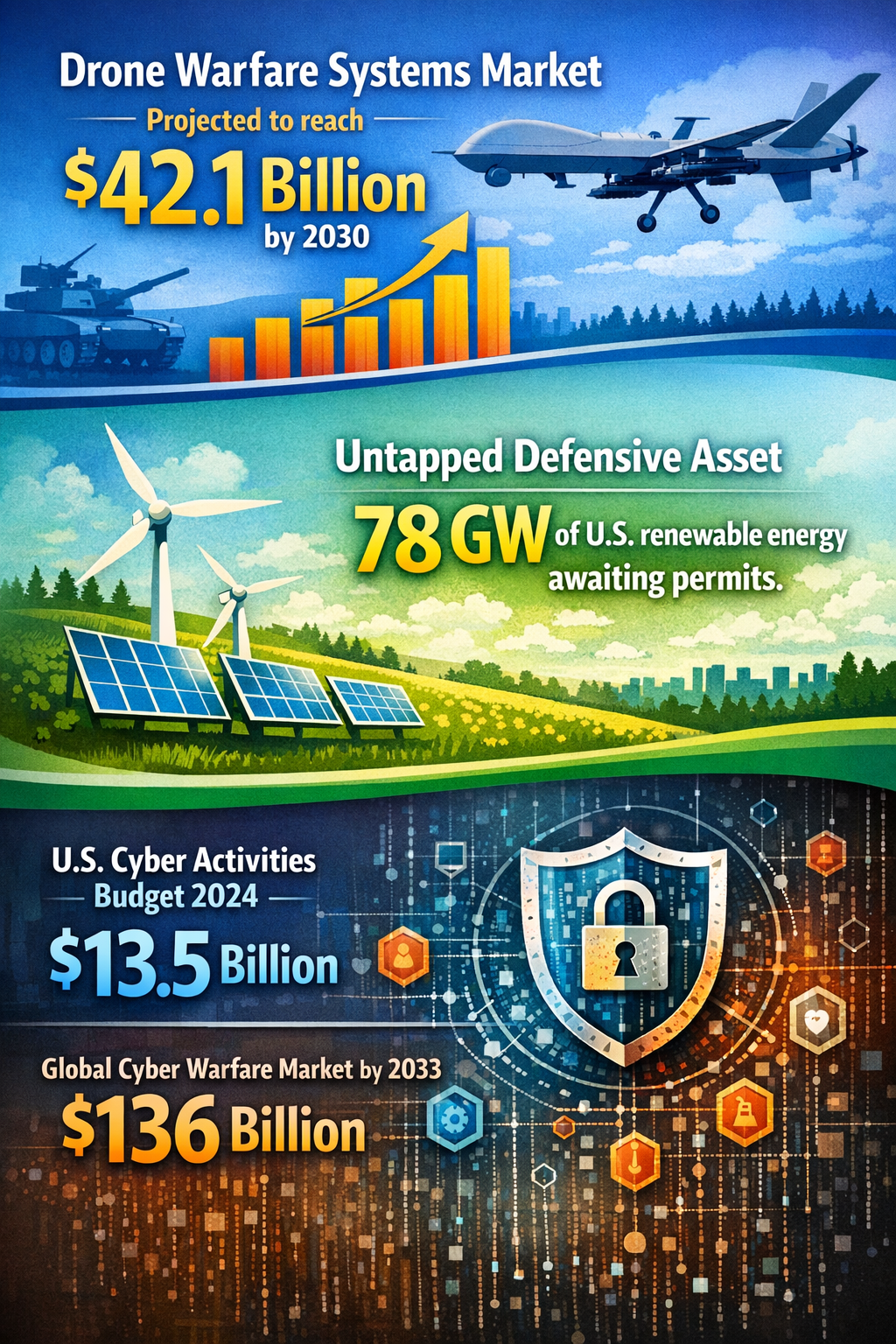
Energy Infrastructure as a New Frontier in the Weaponization of Everything
Emerging beyond conventional drone and cyber warfare, the latent weaponization of energy infrastructure—especially stalled renewable power assets—represents an underappreciated weak signal with potential to disrupt military capability, industrial resilience, and geopolitical stability over the next two decades.
While existing discourse on the weaponization of everything largely focuses on missile proliferation, autonomous drones, and AI-augmented cyber conflict, a genuinely non-obvious inflection is emerging: the militarization and strategic exploitation of constrained energy infrastructure, notably renewable energy projects stuck in permitting and regulatory limbo. This weak signal undermines foundational defense assumptions, challenges capital allocation priorities, and may catalyze significant shifts in governance paradigms, energy sector industrial structure, and strategic risk profiles in both civilian and military domains.
Signal Identification
This development qualifies as a weak signal with medium to high plausibility over a 10–20 year horizon. It is under-recognized within defense and industrial sectors yet has latent potential to escalate given accelerating geopolitical competition, energy transition complexities, and technological interdependencies. The sectors exposed include national defense, energy infrastructure, regulatory oversight, and supply chains involving critical energy technologies and data centers.
What Is Changing
Recent analyses document a resurgence in great-power competition involving China and other actors leveraging rapid advances in missile, cyber, and space capabilities (Defence Connect 01/03/2026). While much attention focuses on kinetic systems and drone warfare evolution (Jerusalem Post 25/02/2026), an overlooked theme is the strategic impotence introduced by deficient energy infrastructure linked to renewables. A recent report notes that the United States alone has nearly 78 gigawatts of renewable capacity stranded in permitting limbo, representing an untapped national defense critical asset (Forbes 01/03/2026).
This bottleneck clashes with the growing digitalization of warfare and the expanding energy needs of AI-driven operations and data centers, which are simultaneously exacerbating electricity demand in the cyber warfare domain (AGT Technology 12/02/2026). The nexus formed by stalled renewable energy projects, the rising electricity consumption of military and intelligence AI systems, and the fragility introduced by supply chain constraints creates a novel systemic vulnerability.
Furthermore, as drone warfare—including first-person view (FPV) drones—proliferates globally (Drone Warfare Research 20/02/2026), dependable low-latency communications backed by robust energy inputs (including fiber-optic networks) become mission critical (Atlantic Council 15/02/2026). Energy infrastructure thus shifts from being a mere enabler to a contested domain in its own right.
Disruption Pathway
The latent weaponization potential of energy infrastructure could scale structurally across several causal steps. Firstly, geopolitical tensions may accelerate policies to exploit vulnerabilities inherent in renewable energy project delays. Adversarial state and non-state actors might target the fragile permitting and capital flows underpinning these assets through cyber incursions or sophisticated supply chain attacks, undermining energy availability essential for AI-enabled command, control, and communications.
This would stress existing defense doctrines that still presume protected geography and extended warning times, forcing drastic tactical recalibrations and spurring urgent capital reallocation toward energy resilience rather than primarily kinetic or drone-centric arms (Drone Warfare Research 20/02/2026). Existing regulatory frameworks around energy permitting and infrastructure security may be insufficiently agile to manage the heightened risk, prompting structural upheaval in governance and oversight bodies.
In response, military and industrial actors might adopt a new paradigm focused on integrated energy-military complexes emphasizing rapid deployment of microgrids, hardened renewable technologies, and digitally resilient architectures. This shift could produce feedback loops as competition over energy infrastructure security intensifies, reorienting industrial supply chains toward dual-use energy-defense technologies. Unintended consequences might include acceleration of energy nationalism, fragmentation of international energy markets, and complex new liability regimes related to attribution of attacks on civilian energy infrastructure supporting military functions.
Dominant industrial models in both the energy and defense sectors could thus transition away from siloed, project-centric investments to cross-sector integrated platforms balancing distributed energy generation with cyber-physical security, fundamentally realigning capital allocation and strategic positioning.
Why This Matters
For senior decision-makers in capital deployment and regulation, this weak signal highlights the risk of underinvestment in energy infrastructure resilience that may be weaponized indirectly in future conflict theatres. Capital markets may undervalue renewable energy projects not solely by traditional commercial metrics but due to emergent strategic risk factors related to geopolitical fragility and digital warfare dependencies.
Regulators should anticipate pressure to accelerate permitting processes, incorporate national security risk assessments explicitly in energy policies, and create new frameworks for cross-industry collaboration. Competitive positioning in both defense and industrial technology sectors could hinge increasingly on capabilities to secure, control, and quickly adapt energy infrastructure in conflict or crisis scenarios.
Supply chains for advanced energy technologies—batteries, microgrid controllers, fiber-optic communications—will likely experience new stratifications, as controlling energy nodes becomes as critical as offensive and defensive weapon systems. Liability frameworks might also evolve as state and private sector actors face complex accountability for cascading failures or exploitation of energy assets.
Implications
This weak signal may reshape the weaponization landscape such that energy infrastructure itself becomes a front line rather than merely a logistic support system. Energy systems may increasingly be engineered with intentional redundancy, hardening, and digital defense layers, possibly making capital allocation decisions in energy more sensitive to geopolitical risk than to immediate economic returns.
This development is unlikely to be a short-term disruption but could unfold as a slow-burn inflection, reinforcing and amplifying structural stress on defense doctrines, industrial policy, and regulation. It should not be conflated with transient cyber attacks or incremental energy grid modernization efforts, which do not fundamentally alter the strategic calculus about energy’s role in conflict.
Competing interpretations may argue this is an extension of existing critical infrastructure protection priorities rather than a distinct weaponization domain. However, the scale of renewable energy permitting stagnation combined with accelerating digital military dependencies supports viewing this as a novel inflection, not merely an incremental trend.
Early Indicators to Monitor
- Surges in defense and intelligence investment related to energy infrastructure cybersecurity and resilience projects
- Changes in renewable energy permitting legislation incorporating national security provisions
- Patent filings or venture capital flows in dual-use energy-defense technologies (e.g., microgrids with cyber-hardened controls)
- Increased incidents of cyber or physical sabotage targeting stalled or critical renewable energy assets
- Formation of new standards or interagency collaborations focused on energy system defense integration
Disconfirming Signals
- Rapid resolution and acceleration of renewable energy permitting and deployment without integration of security enhancements
- Stabilization and reduction in geopolitical tensions reducing incentive to weaponize civilian infrastructure
- Effective international regulatory regimes emerging that decouple military vulnerabilities from civilian energy projects
Strategic Questions
- How can capital allocation frameworks incorporate strategic risk related to stalled energy infrastructure in conflict scenarios?
- What regulatory reforms are required to embed national security risk into energy permitting and project lifecycle management?
Keywords
Energy Infrastructure; Weaponization; Renewable Energy; Cyber Security; Capital Allocation; Geopolitics; Digital Warfare; Permitting; Industrial Structure
Bibliography
- The rise of great-power competition, particularly involving China alongside rapid advances in missile technology, cyber warfare and space capabilities undermined the foundational assumptions of the DOA era, notably the protective value of geography and extended warning times. Defence Connect. Published 01/03/2026.
- Drone warfare has rapidly evolved in the Russia-Ukraine War, as have countermeasures, providing the Israeli military with an opportunity to preempt greater adoption of FPV drones by the Islamic Regime with best defence practices. Jerusalem Post. Published 25/02/2026.
- AI-driven cyber warfare is already reshaping the global threat landscape. AGT Technology. Published 12/02/2026.
- While Tehran vows retaliation and the threat of global cyber warfare looms, the U.S. is sitting on a massive, untapped defensive asset: nearly 78 gigawatts of renewable energy currently stuck in permitting never land. Forbes. Published 01/03/2026.
- As drone warfare proliferates globally, the ability to avoid jamming will continue to attract attention wherever electronic interference is common or expected. Atlantic Council. Published 15/02/2026.